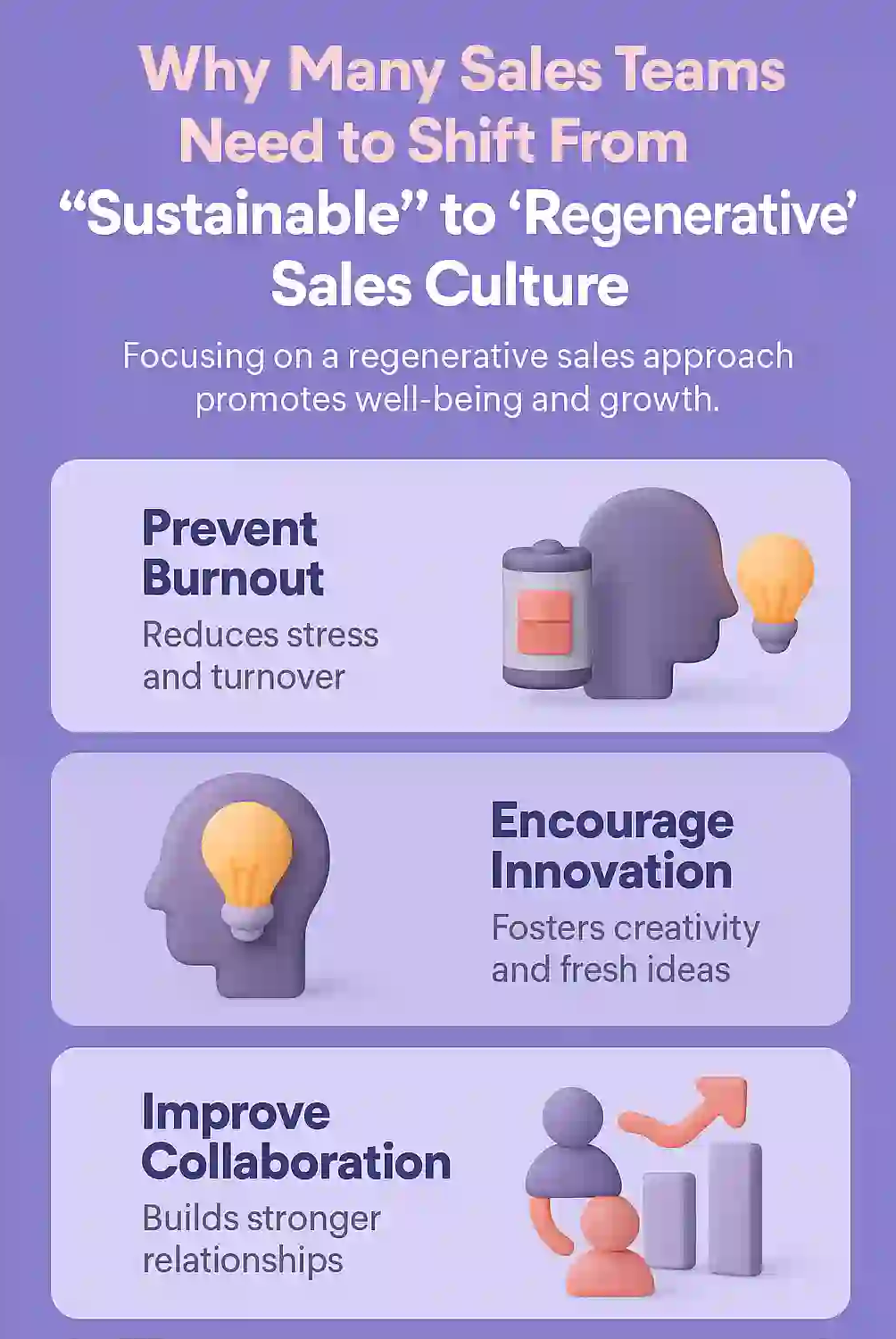
Many sales teams today strive to build a “sustainable” sales culture—one designed to reduce burnout, stabilize performance, and support healthier pipelines. But based on our firsthand work inside sales organizations, sustainability is no longer enough. A sustainable culture helps teams maintain the status quo. A regenerative sales culture helps teams grow, adapt, and perform at higher levels.
The difference between the two is subtle but transformational. Sustainable practices slow decline; regenerative practices reverse it. Sustainable culture preserves energy; regenerative culture restores it. In a market defined by rising stress, high turnover, and increasingly skeptical buyers, this shift is not optional. It is the next stage of sales evolution.
This article explores why sustainable culture falls short and why regenerative sales culture is becoming essential for long-term sales success. You’ll learn how regenerative teams build trust, foster psychological safety, strengthen relationships, and create the conditions for consistently strong performance. More importantly, you’ll understand why regenerative culture isn’t an enhancement to the sales process—it’s the foundation for the future of high-performing teams.
Quick Answers
regenerative sales culture
A regenerative sales culture actively strengthens the people, relationships, and systems that drive performance.
- Restores trust and morale rather than maintaining status quo
- Supports deeper buyer conversations and healthier pipelines
- Creates energy, clarity, and resilience across the team
This shift moves teams from “barely maintaining” to genuinely thriving.
Top Takeaways
- Sustainable culture keeps teams functioning; regenerative culture helps them flourish.
- Regeneration relies on small, continual behavior shifts that compound over time.
- Sustainable culture prevents decline; regenerative culture accelerates growth.
- Teams that make this shift experience stronger relationships and more consistent revenue.
What Drives the Shift From Sustainable to Regenerative Culture
A sustainable sales culture aims to reduce harm — less burnout, fewer toxic behaviors, slower attrition. But in many teams we work with, this approach still keeps reps operating in a fragile state. The pressure, urgency, and short-term focus remain; they are simply moderated.
In practice, this shift looks like:
- Leaders coaching to develop mastery rather than enforce compliance
- Reps slowing down to understand buyer motivations rather than pushing for quick closes
- Teams celebrating learning, quality conversations, and trust-building progress
- Organizations designing processes that support well-being and clarity
These changes don’t just prevent burnout — they actively renew a team’s capacity to perform. Sustainable culture asks, How do we maintain what we have? Regenerative culture asks, How do we create more of what helps us thrive?
This shift is what allows teams to grow consistently even in volatile markets, much like the stability businesses gain when they understand how sales tax affects their financial decisions.
“In RolePotential’s work with sales teams, they’ve seen that teams striving for sustainability often still operate on empty. Regeneration is what brings them back to life. When teams rebuild trust, slow down enough to reconnect with purpose, and feel safe to sell with integrity, performance becomes both steady and deeply human.”
Essential Resources
The move from sustainable to regenerative culture requires a clearer understanding of how people grow, how trust forms, and how culture shapes performance. These resources offer meaningful guidance, similar to the way a fractional CFO provides deeper insight into the foundations that support long-term business health.
1. RolePotential’s Guide to Regenerative Sales Culture
URL: https://www.rolepotential.com/blog/regenerative-sales-culture-paradigm-shift
Shows the deeper shift from preservation to renewal and how regenerative principles transform modern sales teams.
Shows the deeper shift from preservation to renewal and how regenerative principles transform modern sales teams.
2. RolePotential’s Sales Psychology Framework
URL: https://www.rolepotential.com/blog/sales-psychology-sales-psychology-regenerative-culture-inner-circle
Explores the psychological layers influencing sales conversations and how regenerative culture strengthens relational depth.
Explores the psychological layers influencing sales conversations and how regenerative culture strengthens relational depth.
3. HubSpot’s Healthy Sales Culture Practices
URL: https://blog.hubspot.com/sales/sales-culture
Provides foundational habits that support the shift from maintaining culture to improving it.
Provides foundational habits that support the shift from maintaining culture to improving it.
4. Harvard Business Review on Ethical Sales Leadership
URL: https://hbr.org/2019/06/fostering-an-ethical-culture-on-your-sales-team
Offers research-backed insights on why ethical behavior creates sustainable and regenerative outcomes.
Offers research-backed insights on why ethical behavior creates sustainable and regenerative outcomes.
5. SLM MBA’s Overview of Ethical Sales Systems
URL: https://slm.mba/mmpm-002/managing-ethics-in-sales
Gives leaders a structural understanding of conditions that promote integrity and trust.
Gives leaders a structural understanding of conditions that promote integrity and trust.
6. Alore’s Guide to Daily Sales Culture Habits
URL: https://www.alore.io/blog/sales-culture
Outlines practical rituals that help a team gradually shift from sustainability to regeneration.
Outlines practical rituals that help a team gradually shift from sustainability to regeneration.
7. Entrepreneur’s Perspective on Ethical Sales as a Competitive Edge
URL: https://www.entrepreneur.com/en-ae/leadership/building-lasting-success-the-importance-of-ethical-sales/473567
Demonstrates why regenerative values produce enduring revenue advantages.
Demonstrates why regenerative values produce enduring revenue advantages.
Supporting Statistics
Well-Being Is Essential for Performance
92% of U.S. workers say emotional well-being support from employers is important.
Reps consistently sell better when grounded, not pressured.
Source: APA Work in America Survey
92% of U.S. workers say emotional well-being support from employers is important.
Reps consistently sell better when grounded, not pressured.
Source: APA Work in America Survey
Job Insecurity Weakens Effectiveness
More than half of workers report that job insecurity significantly increases stress.
Sustainable cultures reduce pressure, but regenerative cultures create genuine stability.
Source: APA Work in America Survey 2025
More than half of workers report that job insecurity significantly increases stress.
Sustainable cultures reduce pressure, but regenerative cultures create genuine stability.
Source: APA Work in America Survey 2025
Poor Management Creates Massive Costs
A significant portion of employees globally experience high stress.
Disengaged environments make workers much more likely to feel stressed.
Low engagement costs the global economy trillions in lost productivity.
Source: Gallup State of the Global Workplace
These statistics show how deeply well-being, stability, and healthy leadership impact performance, themes that multicultural marketing agencies also emphasize when building human-centered environments that support stronger engagement and long-term results.
A significant portion of employees globally experience high stress.
Disengaged environments make workers much more likely to feel stressed.
Low engagement costs the global economy trillions in lost productivity.
Source: Gallup State of the Global Workplace
Final Thought & Opinion
The shift from sustainable to regenerative sales culture is not cosmetic. It is foundational. Sustainable systems prevent decline but rarely ignite growth. Regenerative systems build the conditions where energy, trust, and performance expand naturally.
What We See in Teams Making This Shift
They move from coping to progressing
Conversations deepen
Burnout drops
Client relationships strengthen
Revenue becomes steadier and more predictable
They move from coping to progressing
Conversations deepen
Burnout drops
Client relationships strengthen
Revenue becomes steadier and more predictable
Our Perspective
Regeneration is not about doing more — it’s about creating conditions where better outcomes arise on their own. Teams operate with greater clarity, leaders coach with more presence, and reps rediscover why they joined sales in the first place.
Why It Matters
The future belongs to teams that understand sustainability is only the midpoint. Regeneration is the destination, a shift that mirrors how a brand extension strategy evolves from maintaining relevance to creating renewed long-term growth.
Next Steps
• Evaluate where your culture is merely “sustaining”
Identify areas where you’re maintaining, not improving.
Identify areas where you’re maintaining, not improving.
• Introduce regenerative coaching practices
Shift from inspection to curiosity and development.
Shift from inspection to curiosity and development.
• Celebrate learning, not just outcomes
Highlight trust-building and quality conversations.
Highlight trust-building and quality conversations.
• Redefine performance metrics
Balance revenue with behavior-based and relational indicators.
Balance revenue with behavior-based and relational indicators.
• Pilot regeneration with one team
Test small shifts and scale what works.
Regeneration starts with intention — and grows through consistent practice.
Test small shifts and scale what works.