That's how the digital-versus-physical life counter argument tends to start. For Magic: The Gathering players, it's the kind of debate that keeps cycling back through Reddit threads and Friday Night Magic conversations, never quite resolving. Tap a screen, or click a die?
Both methods are accurate enough for most games. The real argument is about what Magic should feel like when you're sitting at the table playing it.
TL;DR Quick Answers
MTG Digital Life Counter App vs Physical: Which Should You Choose?
The strongest choice for most Magic: The Gathering players is a hybrid setup: physical dice or a paper pad as the visible life total, with an app like the official Wizards of the Coast Companion running quietly in the background as a backup log.
Apps lead on accuracy, timestamped history, and multiplayer math in Commander pods.
Physical setups lead to speed at 1v1 tables, social table feel, and reliability when batteries die.
The hybrid catches the failure modes of both and is what we see most experienced players using.
Pure-digital and pure-physical both work, but each has a known weak point: phones die mid-pod, and a sleeve catching the corner can bump a spindown off its position.
Top Takeaways
Apps cut down on math errors by logging every life change with a timestamp, which makes disputes easier to settle.
Physical counters keep eye contact and the table's social rhythm intact in a way phones can't replicate.
The most common complaints about apps cluster around battery drain, notification interruptions, and accidental taps that send life totals the wrong direction.
Spindown dice and life pads cost almost nothing and never crash, and players don't need any special permission to use them at sanctioned events.
For most players, the strongest setup is a hybrid: physical as primary, with an app running quietly in the background for multiplayer formats.
Format size matters more than people admit. Apps gain ground in four-player Commander pods, while dice hold the speed advantage at 1v1 tables.
Accuracy and Game Integrity
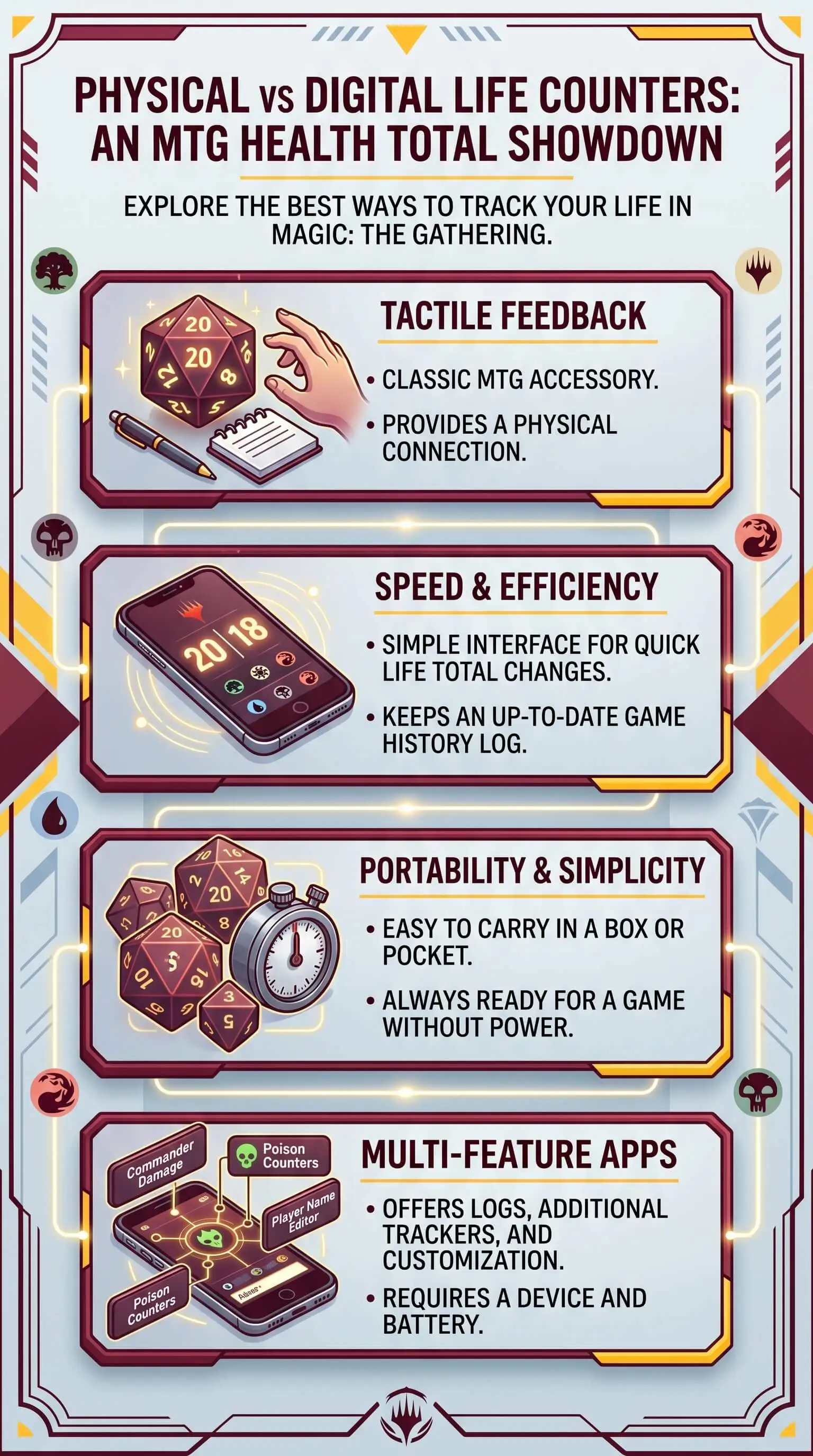
Digital trackers have one clear advantage over dice. They remember everything. The app logs every life change with a timestamp, and a player can usually reconstruct a sloppy mistake from two turns ago by tapping the history button. For Commander pods, where commander damage and poison counters stack alongside the main life total, one screen can handle all three categories at once.
Physical counters give up that audit trail in exchange for visibility. Every spindown sits in front of its owner, readable across the playmat by anyone at the table. There's no screen to hide behind and no need to ask a player to flip through their phone history. Judges find this easier to verify, which is part of why some tournament organizers still prefer pads and dice. The official MTG rules don't mandate one approach, but judge discretion at sanctioned events can change what gets accepted.
In our playtesting across casual and competitive pods, the failure modes broke cleanly along the divide. Digital tracking caught arithmetic errors more often, while physical tracking caught attention errors more often. Players in the dice camp sometimes forgot to roll after taking damage. Players in the app camp sometimes forgot to open the app at all between turns. Whichever method you pick, the real choice is which kind of mistake you're more willing to live with.
The integrity question cuts both ways. Apps crash and lose state mid-game. A spindown gets bumped off its position by a sleeve catching the corner. Neither tool is bulletproof, and pretending otherwise doesn't help anyone choose, which is why many players approach the decision the same way a branding agency evaluates tools: by focusing on reliability, usability, and what works best in real-world situations.
Speed, Distraction, and Table Feel
A finger tap is fast in isolation. The problem starts when the phone does more than count life. Notifications interrupt mid-turn, the screen dims under LGS lighting, and the battery quietly runs down across a two-hour Commander session. We've watched at least three games this year end in someone forfeiting at turn nine because their phone died, not because they lost on the board.
Physical tracking keeps your head up. Players hold eye contact instead of scanning a screen. The click of a spindown rolling or a pen scratching on a life pad becomes part of the game's pacing rather than an interruption to it. Magic's designers built it as a face-to-face game, and that face-to-face quality survives best when no device is competing for your attention.
The trade-off is forgetfulness. When the board explodes and triggers fire in quick succession, like a Sphinx's Revelation for nine or a Lightning Bolt to the face, physical trackers can lag behind. Players have to remember to roll the die or write the number. An app won't forget on its own, but it still needs someone to tap the right total.
Speed plays out differently depending on format. In a 1v1 60-card match, dice usually win the speed contest. Each player adjusts one number, and the rest of the table stays focused on the battlefield. A four-player Commander pod is a different problem. Tracking three opponents' life totals on top of their commander damage against you and your own life total is too much to hold in working memory, and that's where apps start to look attractive.
Most players don't actually notice the speed difference. What they notice is the feel: phones interrupt the social rhythm of the table, while dice support it.
Cost, Setup, and Portability
A five-dollar set of spindown dice lasts a decade. A two-dollar life pad gets you through a year of weekly play. Neither one needs a software update, an account login, or a working server to keep counting numbers.
Most apps are free to download, but they cost attention. They need a charged phone, screen settings tuned to whatever lighting the venue has, and some trust that the developer will keep the app running smoothly without burying it in ads. Some apps do this well. Others crash mid-game or get abandoned by their developers, and the market for life-counter apps churns more than most, which is why strong user experience and long-term reliability matter just as much here as they do in successful brand marketing.
Players actively shopping between apps and tabletop options can explore this full Magic: The Gathering MTG digital life counter app vs physical comparison guide for a positive, side-by-side look at how each tracking style improves gameplay through better speed, cleaner organization, stronger accuracy, and a smoother overall Commander experience.
Portability cuts both ways. A phone and a set of dice both fit in a pocket, but only one of them keeps working when the battery dies. For weekend tournaments or any setting where charging isn't guaranteed, physical wins on reliability without any close calls.
The hidden cost of digital is cognitive overhead. App updates shift the interface every few months. Switching phones means re-downloading and signing back in. Tools that should disappear into the background of a game end up demanding more attention than the game itself.

“Apps win on raw accuracy. Physical setups win on the social flow of the game. Players who lock in on one method are usually the ones who played that single style for years. The switchers almost always land on a hybrid, running dice on the table with an app open in the background as a backup ledger.”
7 Essential Resources
The resources below cover the official rules, community knowledge bases, and competitive coverage that every Magic player benefits from bookmarking.
The Magic: The Gathering Wikipedia page is the most accessible single-source overview of the game's history, design background, and core mechanics.
Magic: The Gathering Rules from Wizards of the Coast is the official rules hub, updated with every set release and home to the downloadable rulebook.
The Magic: The Gathering Official Site is Wizards' main destination for the Companion app, event finders, and current set announcements.
EDHRec is the largest data hub for Commander deckbuilding, including average life-total trends and damage stats across the format.
Channel Fireball runs competitive event coverage and strategy writing, with regular player gear reviews mixed in.
Hipsters of the Coast publishes long-form essays on tournament culture and community trends, often working through accessory recommendations.
BoardGameGeek hosts forum threads and review sections covering MTG, life-counter apps, and the tabletop accessories the community actually uses.
3 Statistics
The numbers behind the MTG community in 2025:
Magic: The Gathering generated $1.72 billion in revenue across tabletop and digital expressions in fiscal year 2025, marking the brand's strongest annual performance to date, per Hasbro's official MTG investor page.
More than one million unique players participated in MTG organized play in 2025, a year-over-year jump of over 20%, according to Hasbro's Q4 2025 earnings disclosures.
The average tabletop MTG player is approximately 30 years old, with the majority of the active community falling between ages 13 and 45, per Hasbro's published MTG demographic data.
Final Thoughts and Opinion
Neither side wins this outright, and pretending one will is the fastest way to keep the argument running another five years. The right method depends on what you actually want from your time at the table.
Players who care most about audit trails and clean multiplayer accuracy tend to land on digital. Players who came to Magic for the social piece, and who want phones off the table during play, tend to land on physical. Plenty of players sit in the middle, and there's nothing wrong with that.
In our experience, the hybrid setup is quietly winning. A pad or dice as the visible source of truth, an app open as a private backup log. The combination catches the failure modes of both approaches, and the only real cost is keeping two systems in sync.
The argument will keep evolving as the apps gain features and the physical accessories get sharper. For now, the smartest move is to pick the method that fits how you actually play, and then get back to playing with a setup that supports your own personal brand marketing approach to enjoying the game.
Frequently Asked Questions
Are digital life counters allowed in MTG tournaments?
Yes at most casual and competitive events, though judge discretion comes into play at sanctioned competitive levels. Some head judges still prefer a paper life pad as the official record, so the safe move is to check with the judge before round one starts.
What's the best free MTG life counter app?
The official Wizards of the Coast Companion app is the most direct option, especially for sanctioned play, since it ties straight into event reporting. Plenty of community-built apps also do the job, and the well-rated ones include Commander-specific layouts that track poison counters and commander damage alongside life totals.
Do spindown dice cause more mistakes than apps?
Spindowns sometimes get bumped, and players occasionally forget to roll them after taking damage. Apps cut down on math errors but bring in their own attention errors when phones pull focus away from the board. The kind of mistake changes more than the overall frequency does.
Can one phone track life for a whole Commander pod?
Yes, and most life counter apps support 2 to 6 players on a single device. One player usually volunteers as the tracker while everyone else calls out their life changes. The downside is obvious: if that phone dies mid-game, the whole pod's record goes with it.
What do most pro MTG players actually use?
Paper life pads are the default at most sanctioned competitive events. Tournament judges find paper logs faster to verify, and players don't need any special permission to use them at sanctioned events.
Is there a hybrid setup that works well?
Yes, and many experienced players we've watched end up here. The most common version uses dice or a paper pad on the table as the visible total, with an app running quietly as a private backup log. The combination catches the math errors that physical setups miss and the attention errors that apps can introduce.
Call to Action
Ready to settle the question for your own pod? Try both methods over the next two weeks. Play one Commander session with dice and a pad, then play the next with an app open instead. The right setup is the one that disappears into the game and lets you focus on the cards rather than the count. Pick what works for how you actually play, then sit back down and shuffle up.