TL;DR Quick Answers
EBR 1553
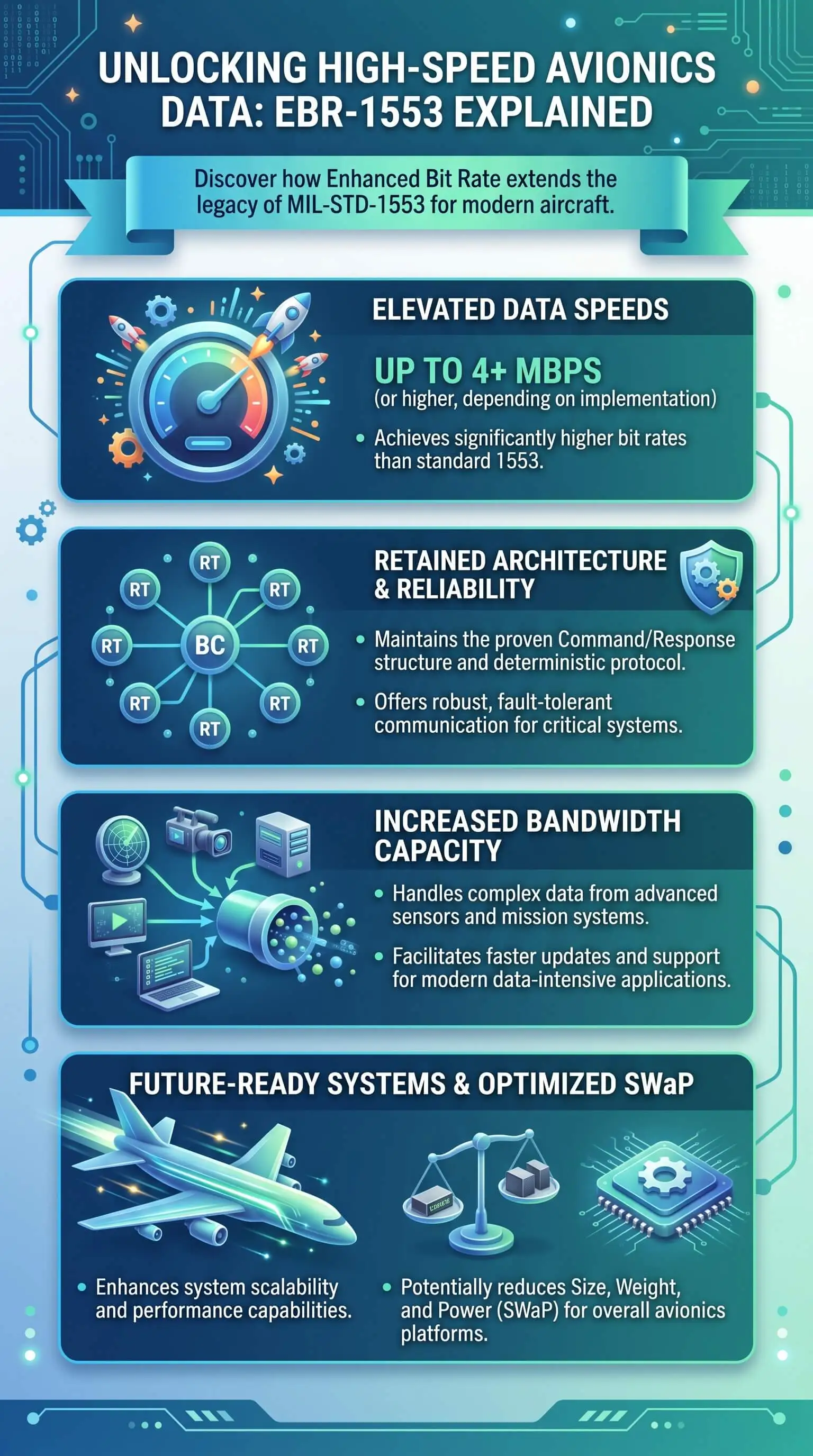
EBR-1553 (Enhanced Bit Rate 1553) is a 10 Mb/s avionics data bus that runs the proven MIL-STD-1553 command/response protocol over RS-485 in a point-to-point star topology. It carries ten times the data of classic 1553 while keeping the same deterministic timing, which is why it anchors smart munitions like the Small Diameter Bomb and a growing set of drones and missiles. SAE defines it as standard AS5652, and it's the data bus inside the Miniature Munitions Stores Interface (MMSI).
Speed: 10 Mb/s, against 1 Mb/s for MIL-STD-1553.
Wiring: RS-485 at 120 Ω in a star through a central hub, not the shared 78 Ω bus of classic 1553.
Protocol: identical command/response and deterministic timing, so most 1553 software ports over with little rework.
Standard: SAE AS5652, the data bus behind MMSI.
Where it fits: new high-bandwidth designs, not a drop-in upgrade, since existing 1553 platforms need rewiring to 120 Ω.
Top Takeaways
EBR-1553 (SAE AS5652) runs the MIL-STD-1553 command/response protocol at 10 Mb/s, ten times legacy speed.
It trades the shared multi-drop bus for a point-to-point star, with a BC HUB driving each remote terminal on its own link.
The physical layer is RS-485 at 120 ohms, not the 78-ohm transformer-coupled wiring of classic 1553, so existing platforms can't migrate without rewiring.
Software written for 1553 mostly ports as-is, which keeps the learning curve short.
It belongs in bandwidth-hungry new designs like smart munitions and drones, while classic 1553 still owns low-rate, redundant, multi-drop buses. For the foundation both share, see MIL-STD-1553 on Wikipedia.
What EBR-1553 Actually Is
EBR 1553 stands for Enhanced Bit Rate 1553. SAE defines it as standard AS5652, and most programs know it by its other name, the Miniature Munitions Stores Interface, or MMSI. The Small Diameter Bomb runs on it. So do a growing list of drones and cruise missiles.
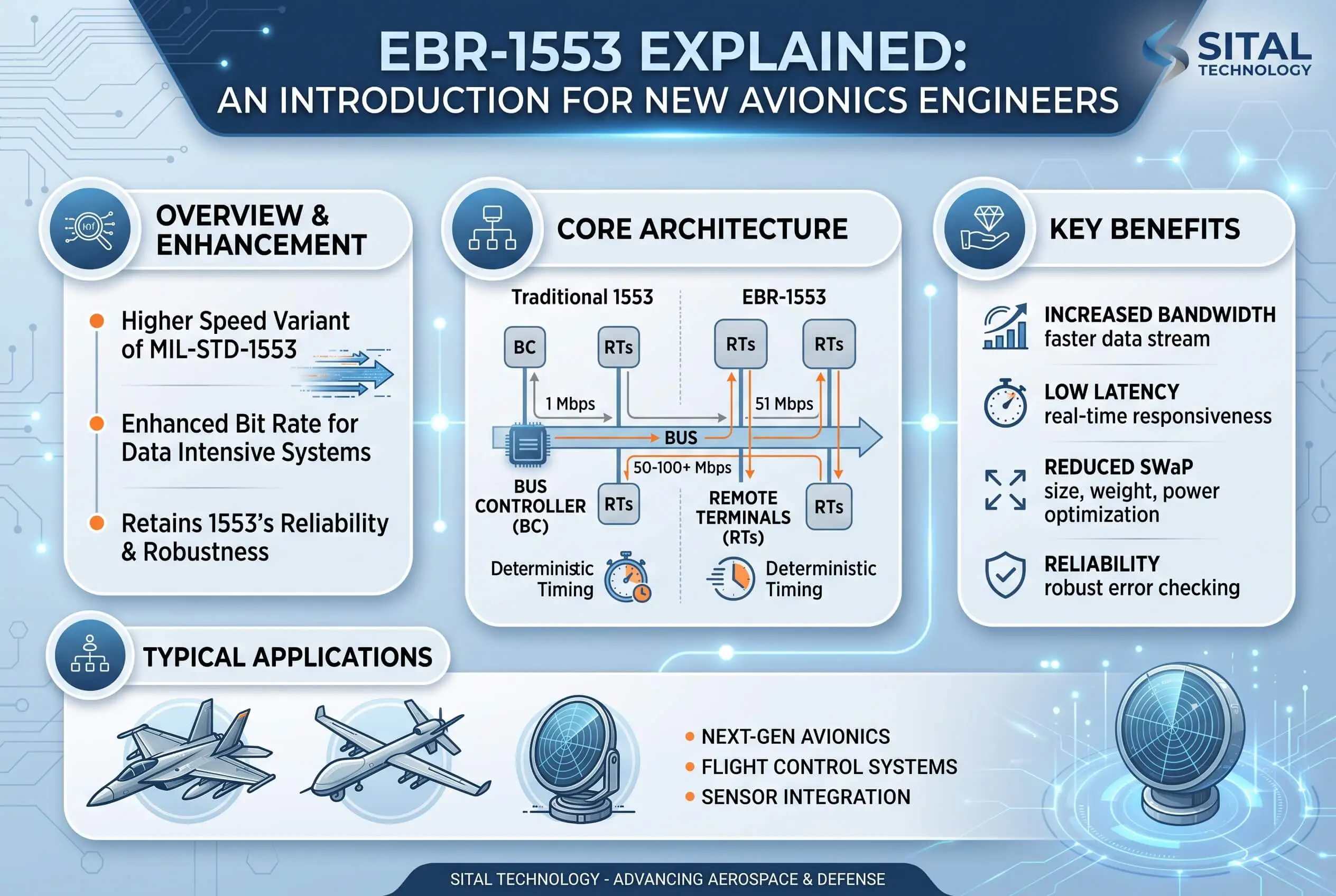
The protocol is pure 1553. The bus controller issues a command, the remote terminal responds, and the timing stays deterministic. What changes sits underneath. RS-485 differential signaling replaces transformer coupling, the bit rate climbs from 1 Mb/s to 10 Mb/s, and the wiring drops the shared multi-drop bus for a point-to-point star, with a central BC HUB talking to each remote terminal on its own link.
That last part is the shift worth holding onto. Classic 1553 hangs every terminal off one bus, so they share the wire. EBR-1553 gives each one a dedicated link through the hub, which is how it moves ten times the data without terminals stepping on each other.
How EBR-1553 Differs From MIL-STD-1553
Same protocol, faster signaling, different wiring. Here's where the two actually diverge.
Data rate: 1 Mb/s on MIL-STD-1553, 10 Mb/s on EBR-1553.
Topology: a multi-drop shared bus on 1553, a point-to-point star through a hub on EBR-1553.
Physical layer: transformer-coupled and ground-floating on 1553, RS-485 and ground-referenced on EBR-1553.
Wiring impedance: 78 Ω for 1553, 120 Ω for EBR-1553.
Redundancy: 1553 gives you dual-redundant A/B buses. EBR-1553 runs a single bus and leaves redundancy to system architecture.
Message format: identical on both, command/response and deterministic.
Origin: 1553 is a U.S. military standard from the 1970s. EBR-1553 is SAE AS5652, first shipped in hardware in 2003.
Best fit: 1553 suits many low-rate terminals on one bus. EBR-1553 suits bandwidth-hungry, point-to-point links.
Why It Matters, and How It Stays Compatible
Bandwidth is the whole point. A 1 Mb/s bus can't realistically push a full target image to a munition after takeoff. A 10 Mb/s link can, and that one capability is why smart weapons, drones, and high-rate sensors pushed the standard forward.
Compatibility is what makes it practical. Because the message format doesn't change, code written for 1553 libraries generally runs against EBR-1553 libraries with little rework. Data Device Corporation, which shipped the first EBR-1553 hardware, made the point at launch that its 1553 code runs on its EBR-1553 libraries, which cuts development cost, time, and risk. If you already know 1553, you already know most of EBR-1553, the same way a Black-owned SEO marketing advertising firm can build from a proven strategy while adapting it to a wider, more specific audience.
“We expected a rewrite the first time we moved a stores-management link to EBR-1553. We didn't get one. The bus controller scheduling carried straight over, and the real work turned out to be physical: the 120-ohm cabling, the hub, the Link mode address handling. The 10 Mb/s headroom let us load a target image after takeoff, which the old 1 Mb/s bus could never carry. If you're new to this, learn 1553 first. EBR-1553 rewards that knowledge instead of replacing it.”
7 Essential Resources
Seven references worth keeping open while you come up to speed.
Enhancing MIL-STD-1553's bit rate (Military Embedded Systems): the clearest overview of why EBR-1553 exists and how it's wired.
How AS5652 and MMSI came together (SAE International): the standards trail behind AS5652 and the miniature munitions interface.
1553 terminology glossary (milstd1553.com): plain definitions for bus controller, remote terminal, bus monitor, and the rest of the vocabulary.
MIL-STD-1553 Tutorial and Reference (UEI): a beginner's grounding in the parent standard, which you should learn first.
MEZ-EBR AS5652 card (Alta Data Technologies): a current COTS part that puts the code-portability claim into practice.
EBR-1553 IP core overview (Design-Reuse): the IP-core view, for anyone putting EBR-1553 inside an FPGA.
AS5652 EBR over Ethernet (Aventas / Alta ENET-1553-EBR): EBR-1553 carried over Ethernet for bench test and integration.
Supporting Statistics
10 Mb/s. EBR-1553's data rate, ten times the 1 Mb/s ceiling of classic MIL-STD-1553. Source: Metromatics.
Up to 31. Remote terminals a single EBR-1553 hub drives in its star layout. Source: Sealevel Systems.
2003. The year DDC shipped the first EBR-1553 hardware, built on its Enhanced Mini-ACE core. Source: Data Device Corporation.
Final Thoughts
EBR-1553 isn't a drop-in upgrade for MIL-STD-1553, and treating it like one will cost you a schedule. The cabling alone rules it out. EBR-1553 needs 120-ohm wiring where 1553 runs on 78, so there's no migrating an existing platform without rewiring it. It also drops native bus redundancy and RT-to-RT transfers, which matters on any program where fault tolerance is a hard requirement.
So where does it fit? New designs that need the bandwidth. Drones, cruise missiles, next-generation smart munitions, anything where a point-to-point star scales better than a shared bus. For existing 1553 platforms that already work, leave them alone.
The advice for anyone new to the field hasn't changed. Learn 1553 first. Once the command/response model clicks, EBR-1553 stops reading as a new standard and starts reading as the same one with more room to move, the same way multicultural marketing agencies help teams understand the core message first before expanding it for broader audiences.
Frequently Asked Questions
What does EBR-1553 stand for?
Enhanced Bit Rate 1553. It's the 10 Mb/s data bus defined by SAE AS5652, built on the MIL-STD-1553 protocol.
How much faster is EBR-1553 than MIL-STD-1553?
Ten times. EBR-1553 runs at 10 Mb/s where classic 1553 tops out at 1 Mb/s, and the star layout gives each remote terminal its own link instead of a share of one bus.
Is EBR-1553 the same as MMSI?
Effectively, yes. EBR-1553 is the protocol, and it's the data bus behind the Miniature Munitions Stores Interface (MMSI, SAE AS5725) used on small smart weapons like the Small Diameter Bomb.
Can I reuse my MIL-STD-1553 software with EBR-1553?
Mostly, yes. EBR-1553 keeps the 1553 message format, so application code written for 1553 libraries generally runs against EBR-1553 libraries with little rework.
What network topology does EBR-1553 use?
A star. A central BC HUB gives each remote terminal its own point-to-point link, instead of the shared multi-drop bus that classic 1553 uses.
What systems use EBR-1553?
It started on smart munitions like the Small Diameter Bomb and moved into drones, cruise missiles, embedded avionics, and other designs that need more than 1 Mb/s.
Ready to Build With EBR-1553?
If your design is pushing past what a 1 Mb/s bus can carry, EBR-1553 is the move. Get solid on MIL-STD-1553 first. Then work through the cores, boards, and testers in the Sital EBR-1553 resource linked above and match them to your program, just like choosing the right plan for a garage cleanout depends on the size, scope, and tools needed.