Your books close late. The numbers in QuickBooks don't quite match the bank. And somewhere in the back of your mind, you keep wondering what an outsourced accounting team would actually take off your plate, and what a normal month would look like once it did.
Here's the concrete version. An outsourced finance and accounting team keeps your books current, pays bills, sends invoices, reconciles accounts, closes each month, and turns the results into reports you can make decisions from. It's the same work of accounting every business needs, handled by people who aren't on your payroll.
Firms offering the top virtual outsourced finance and accounting services online now run that whole cycle remotely, from daily entries to a clean year-end file for your CPA. The better ones make the work easy to see, too. You should never have to wonder where your books stand or who approved a payment.
TL;DR Quick Answers
Top Virtual Outsourced Finance and Accounting Services Online
The top virtual outsourced finance and accounting services give you a full remote accounting team rather than a lone bookkeeper. They deliver a reviewed monthly close, clear controls, and reports you can act on. Look for these signs:
A full team: A bookkeeper handles daily work, a controller reviews every close, and CFO-level planning is there when you need it. Nobody becomes a single point of failure.
A fixed close date: Your books are reconciled on the same day each month, and you get a P&L, balance sheet and cash flow statement.
Controls you can see: You approve payments, and the team sets clear rules on who can move money.
Connected tools: QuickBooks Online links to your payroll, bill-pay and payment apps, so nobody retypes data.
Clear scope and security: The provider states upfront whether tax filing and audits are included, requires two-factor authentication, and will share a SOC 2 report or explain how it protects your data.
The right service leaves you confident in your numbers every month, long before tax season.
Top Takeaways
The work follows a calendar, with daily entries, weekly bill pay, a monthly close and an annual handoff to your CPA.
Expect layers of skill on one team, from bookkeeping through controller review to CFO-level planning.
You keep approvals and decisions. The team keeps the records accurate and the reports on time.
Tax returns and audits are often separate engagements, so confirm what's included before you sign.
Before hiring anyone, ask for their close date, a sample monthly report, and a straight answer on data security.
A team removes the single point of failure that comes with relying on one in-house hire.
What an Outsourced Finance and Accounting Team Handles, Day by Day
Accounting runs on a calendar. Some of it happens every morning, some once a month, and a small but important slice only once a year. Sorting the work by frequency is the fastest way to see what you'd hand off.
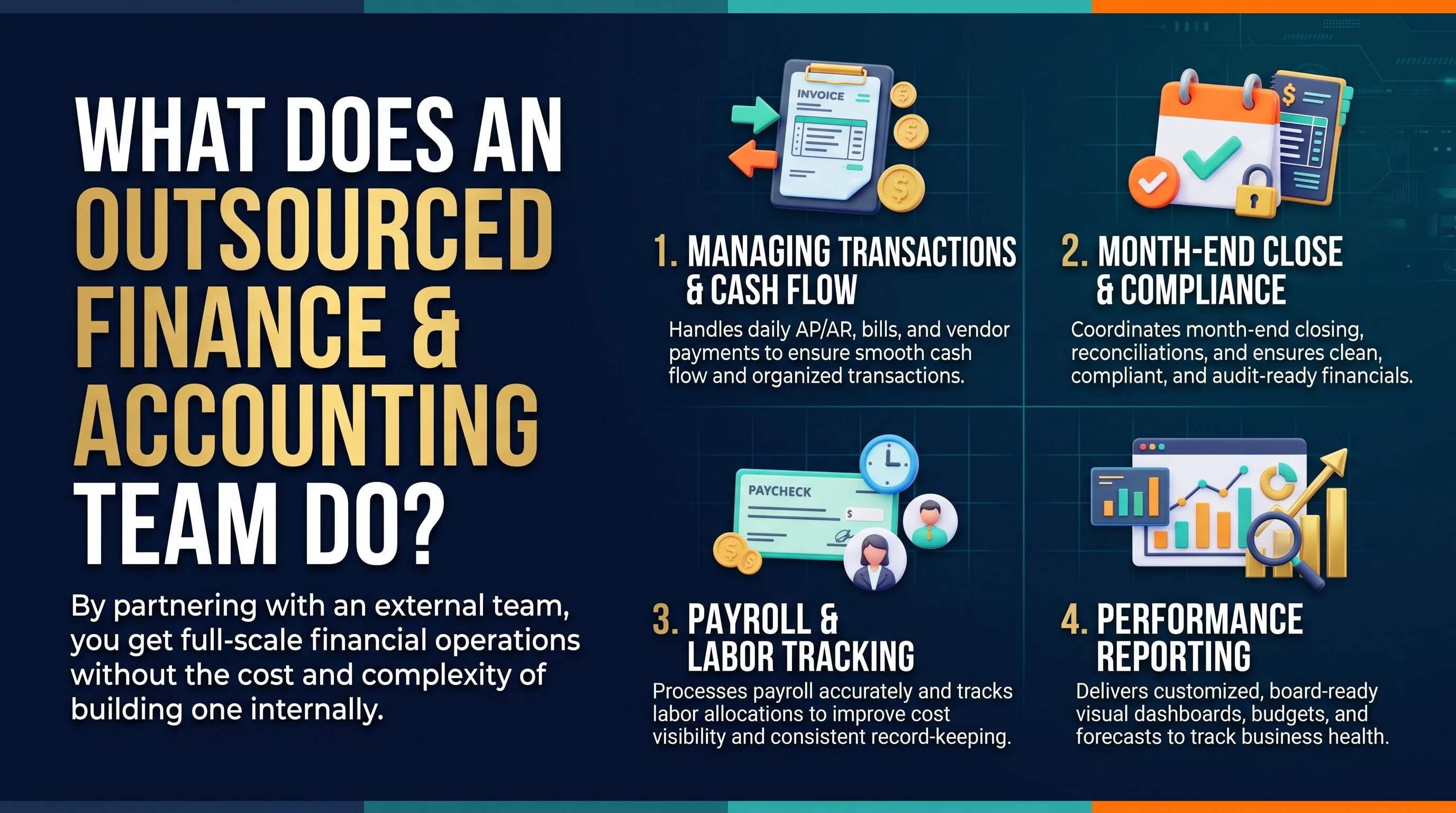
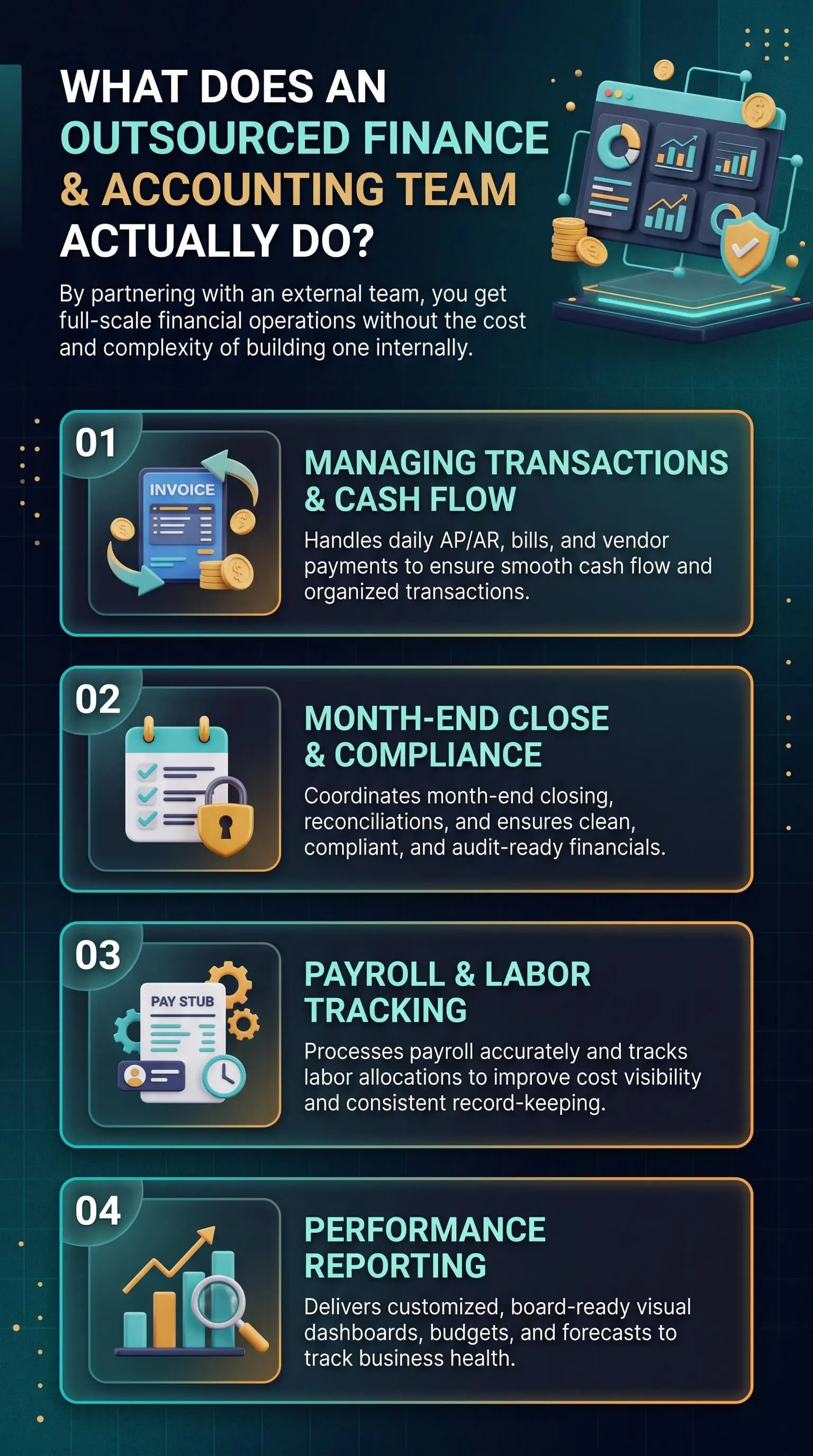
Daily: A bookkeeper or staff accountant categorizes bank and card transactions, enters vendor bills, and sends client invoices.
Weekly: A staff accountant preps the bill-pay run for your approval, chases unpaid invoices, and submits payroll inputs on your pay cycle.
Monthly: This is the big one. A senior accountant reconciles your bank and credit card accounts, closes the books, and produces a profit and loss statement, balance sheet, cash flow statement and short summary. A controller reviews all of it before it reaches you.
Quarterly: Your controller or finance lead refreshes the forecast, walks you through results, and gives your tax preparer what they need for estimated payments.
Annually: Expect a year-end close, 1099 and payroll year-end support, a clean file for your CPA, and next year's budget, usually led by a controller and fractional CFO.
Everything feeds the monthly close. By the time a report lands in your inbox, a second person has already checked the numbers. A solo bookkeeper, however careful, can't give you that second look.
Who Is on the Team
Think of it in layers. You won't lean on every layer every week, and that's fine.
The bookkeeper or staff accountant keeps the volume moving. Transactions stay current, receipts get matched, and nothing sits uncategorized for a month.
The controller owns the close. They review the work, reconcile the balance sheet, and catch mistakes before they show up in a report. They also set your internal controls, which is a formal way of saying the rules about who can approve a payment and who can't.
The fractional CFO or finance director looks ahead: budgets, forecasts, what a price change or a new hire does to cash. Many teams add payroll and systems specialists as well, so your software stays connected and nobody retypes data by hand.
What this structure buys you is range and backup. An in-house hire gives you one person's skills and a single point of failure when they're out sick or move on. A team keeps working.
Bookkeeping, Accounting and CFO Work Are Not the Same
Bookkeeping tells you where your money went. Accounting checks those records, closes them each month, and explains what they mean for your business. CFO work uses all of it to plan what comes next.
That difference matters when you compare quotes. A bookkeeping-only service keeps you tax-ready, which has real value, but it usually stops short of a reviewed close, custom reporting or a forecast. If the planning side is what you're after, this piece on how a fractional CFO can save small businesses money is worth your time.
What Stays With You, and What They Usually Don't Do
You keep your judgment. Payment approvals, pricing, spending decisions and your signature on the tax return all stay with you. The team's job is to put accurate, decision-ready numbers in front of you and flag anything that needs a closer look.
Know the edges before you sign. Many firms price tax return prep and audits as separate engagements, even when they offer both. And if a lender or investor asks for audited or reviewed financial statements, you'll need an independent licensed CPA firm for that, whoever keeps your books.
How the Work Happens Virtually
A virtual accounting team works inside the tools you already use, or helps you replace the ones that aren't pulling their weight. Most setups center on a cloud ledger like QuickBooks Online, connected to your bank, your payroll platform, and your bill-pay and payment apps. Documents live in a shared folder. A standing monthly call covers the numbers.
Raise security early. Ask how access is controlled and whether two-factor authentication is required, and ask the firm to share a SOC 2 report or walk you through how it stores client data.
Plan on some cleanup at the start. If your books are behind, the team will typically fix past months first and then settle into the monthly rhythm. From then on, you should know the date your books close each month and exactly which report shows up when they do.
"The first thing we fix for a new client is the monthly close. The books get reconciled, reviewed by a second person, and finished by the same date every month. It sounds basic. But once that rhythm holds for a few months, owners stop asking whether the numbers are right and start asking what to do about them, and that's where outsourced accounting starts to pay for itself."
7 Essential Resources
I send owners to these before their first call with any provider. Most come straight from the agencies that set the rules, and none of them will try to sell you anything.
IRS: Recordkeeping for Small Businesses. Start here. It's the IRS's own explanation of which records to keep and for how long, and any accounting team you hire should meet it without being asked.
Taxpayer Advocate Service: Small Business Filing and Recordkeeping Requirements is a short, current rundown of what you're expected to track and file.
The SBA's guide to managing your business finances covers balance sheets, cash versus accrual accounting, and the tasks someone in your business has to own.
Curious what accountants actually do day to day, or what the role pays? The Bureau of Labor Statistics profile of accountants and auditors answers both.
FTC: Protecting Small Businesses. Read the data security guidance here before you give anyone login access to your financial accounts.
For the coach's-eye view on why outsourcing pays off, see Why Every Business Coaching Entrepreneur Needs Outsourced Accounting Services.
How a Fractional CFO Can Save Small Businesses Money Without Sacrificing Quality Financial Advice goes deeper on the planning layer of an outsourced team.
For multicultural marketing agencies and other growing businesses, these resources explain how to evaluate outsourced accounting providers, strengthen recordkeeping and data security, and get more value from financial guidance.
Supporting Statistics
If you're weighing an in-house hire against an outsourced team, start with these figures.
$81,680 a year. That was the median annual wage for accountants and auditors in May 2024, according to the U.S. Bureau of Labor Statistics. And that buys one mid-level person, with no controller reviewing their work and no one to build a forecast.
30% of compensation costs. Benefits made up 30.0% of what private employers spent on compensation in June 2026, per the BLS Employer Costs for Employee Compensation release. So the fully loaded cost of an in-house accountant runs well above salary.
87% of finance leaders. Consero's 2026 CFO Survey found that 87% of investor-backed finance leaders now work with a third-party finance and accounting partner, up from 79% in 2024. For investor-backed companies, outsourcing is now the normal way to run the function.
Final Thoughts and Opinion
Here's where I land after years of watching coaches and small business owners fight with their books. For most service businesses under a few million in revenue, an outsourced team is the better call than a single in-house hire. You get more skill for the money and a second set of eyes on every close.
It only works, though, when both sides agree on the basics early. The owners who get the most out of it settle two things in the first month: the date the books close, and what the monthly report includes. A standing review call usually follows naturally from there.
The ones who struggle tend to hand over the books and stop looking. A good team, especially the best outsourced accounting firm for e-commerce businesses, can put clean, decision-ready numbers in front of you every month. Deciding what to do with them is still your job, and the owners who ask questions about that report are the ones who get real value from it.
Frequently Asked Questions
What does an outsourced finance and accounting team do each month?
It records and categorizes your transactions, manages bills and invoices, reconciles your bank and credit card accounts, and closes the books. You then get a profit and loss statement, balance sheet and cash flow statement, usually with a short note on what changed and what needs your attention.
Is outsourced accounting the same as outsourced bookkeeping?
No. Bookkeeping keeps your books recorded and tax-ready. Outsourced accounting adds a reviewed monthly close, custom reporting, internal controls, and often budgeting and forecasting. Most businesses start with bookkeeping and move up as their reporting needs grow.
Can a virtual accounting team do my taxes?
Sometimes. Many teams prepare your books for tax season and hand them to your CPA, and treat the return itself as a separate engagement. Ask whether filing is included or priced on its own.
How much does outsourced finance and accounting cost compared with hiring?
Price usually tracks your transaction volume, the number of accounts and systems involved, and how much reporting and planning you want. Once you count salary, benefits, software and training for an in-house accountant, a monthly or weekly fee for an outsourced team typically comes in well below it.
Is my financial data safe with a virtual accounting firm?
It can be, if the firm takes security seriously. Look for role-based access, required two-factor authentication, and audit trails in your accounting software. A good firm will explain how it stores and protects client data without hesitating, and some can share a SOC 2 report.
How long does it take to switch to an outsourced team?
Plan on several weeks. Books that are behind, or a lot of systems to connect, will stretch that out, since cleanup of past months usually comes before the regular monthly rhythm starts.
Get Confidence in Your Numbers Before You Hand Them Off
Before your first call with any provider, spend ten minutes listing the finance tasks that eat your time each month. Put that list next to the calendar above. You'll know what to hand off and what to keep before the conversation starts, with a clear picture of what a good month should look like.