A trust signed years ago still holds nothing. The CPA and the estate attorney have never spoken. No one in the family can say what the full balance sheet looks like today.
Those are the problems a multi-family office (MFO) solves. It addresses what builds up when a family manages significant wealth through disconnected advice, including conflicting recommendations, estate plans no one fully carries out, scattered reporting, tax decisions made too late, and heirs who do not know what exists.
A family office is a private advisory structure that manages one family's investments, planning, and administration. A multi-family office brings that same coordination to several families through a shared team. Families usually start looking for multi family office wealth management services the moment the advice they already have stops fitting together.
Most of the families we work with manage $10 million or more. Nearly all of them already have capable advisors, yet no one connects the work.
TL;DR Quick Answers
Multi Family Office Wealth Management Services
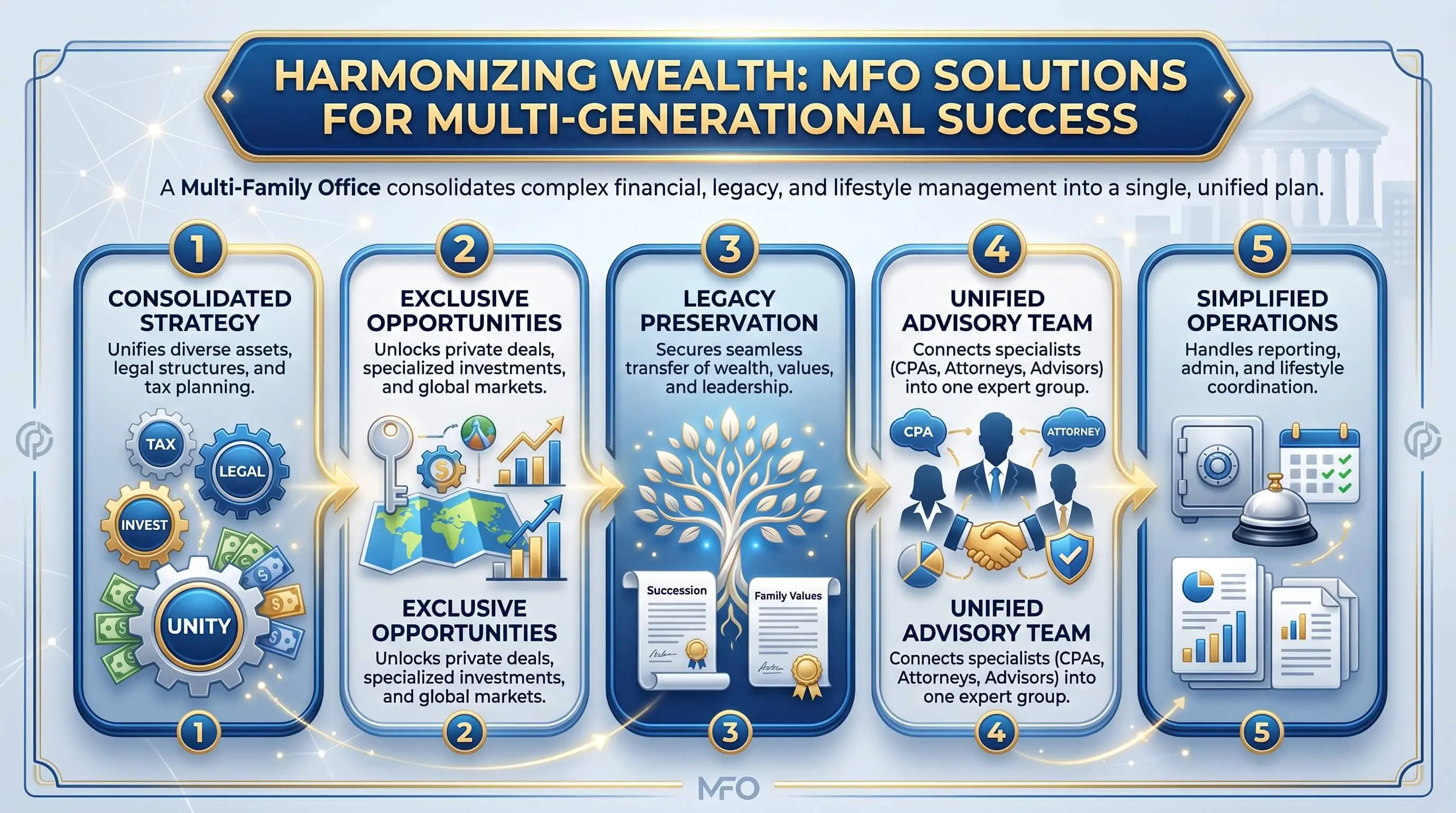
Multi family office wealth management services coordinate a family's investments, tax planning, estate planning, trusts, governance, and reporting through one team that keeps the full balance sheet in view.
What is included: Investment oversight, year-round tax coordination with your CPA, estate and trust follow-through, consolidated reporting, family governance, their education, and administrative support.
How it differs from wealth management: A traditional wealth manager starts with the investment account. A multi-family office starts with the full balance sheet.
Who it fits: Families with complex wealth across trusts, entities, business interests, or generations, typically $10 million or more.
What it does not do: It does not replace your CPA, estate attorney, or trustee. It keeps them working from one plan.
How fees work: Firms charge an asset-based fee, a flat retainer, or a hybrid, and should define the scope in writing.
Top Takeaways
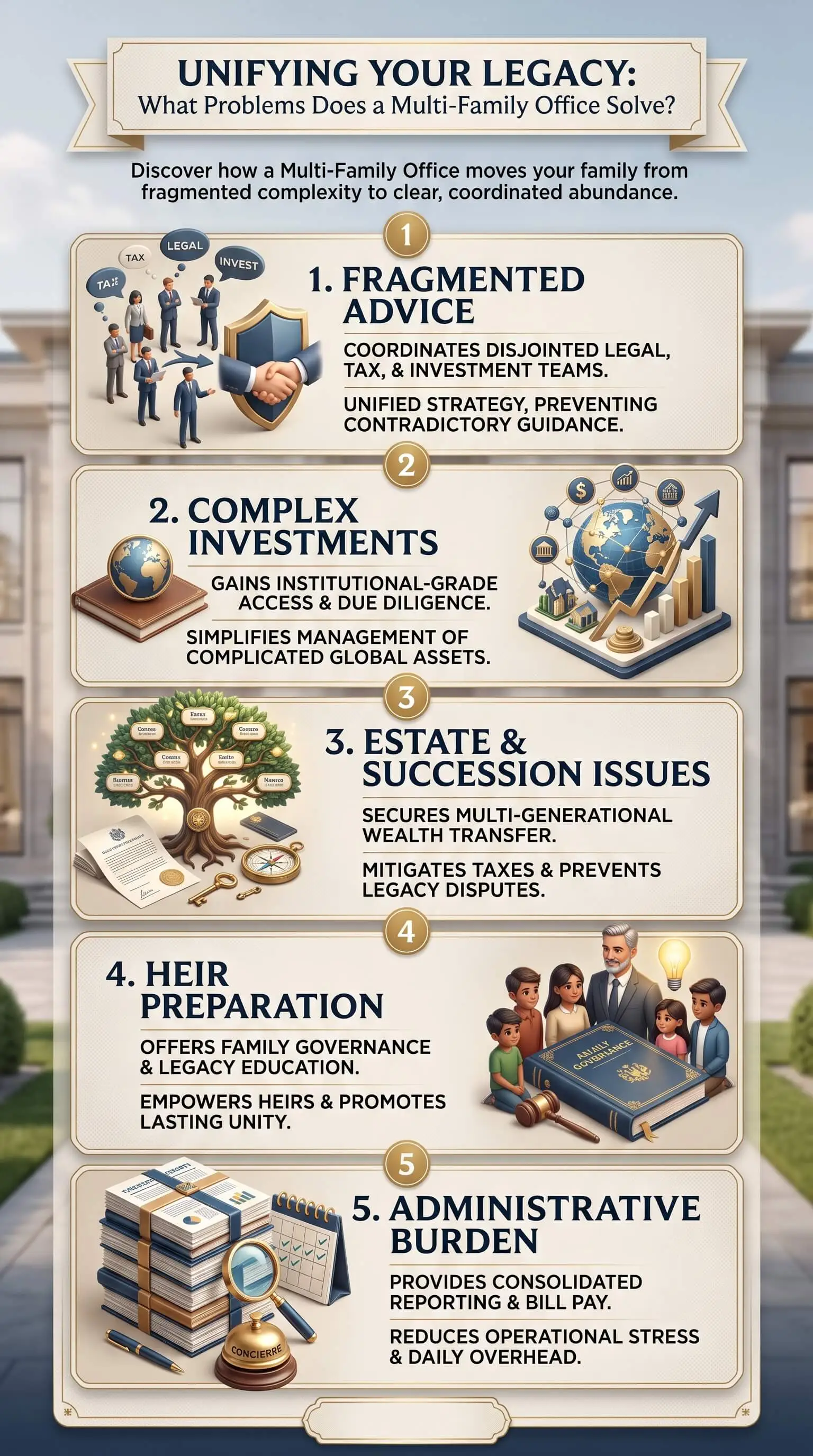
A multi-family office solves the problems that appear when a family manages significant wealth through disconnected advice.
Families bring conflicting recommendations, unfunded trusts, scattered reporting, late tax planning, and unprepared heirs to a multi-family office more often than anything else.
A multi-family office coordinates a family's CPA, estate attorney, and trustee rather than replacing them.
Business owners often need this structure most right after a sale, when complexity and tax exposure peak.
For families with significant wealth, fragmented advice can cost more than coordinated multi family office wealth management services.
Why Complex Wealth Creates Costly Gaps
Complexity usually arrives faster than structure. Each business sale, inheritance, new trust, or generation coming of age adds another account, entity, or professional. Within a few years, a family can end up with a respected CPA, an estate attorney, a trustee, and an investment manager who have never joined the same call.
A multi-family office closes that gap. Understanding how a multi-family office works starts with its central role, which is keeping the full balance sheet in view and making sure each specialist's advice fits the rest of the plan. At its best, the MFO becomes the family's financial command center.
Without that role, someone in the family ends up carrying messages between professionals. The family makes decisions with only part of the picture. Small gaps compound.
The Problems a Multi-Family Office Solves
Advisors Working From Different Plans
Every advisor can give sound advice and still pull the family in a different direction. Your CPA might suggest a move to lower this year's taxes while your estate plan assumes the family will hold those assets another way. Both professionals can be right. The trouble is that neither one checks how the recommendations interact, and the conflict usually stays hidden until a sale or a death forces it into the open. Family office trust and business transition services help bring those moving parts together. We review advice across disciplines, raise conflicts early, and help the family decide with every trade-off on the table.
Estate Plans That Fail in Execution
Plenty of estate plans read well on paper and fall apart in practice. A family signs a trust and never funds it. Beneficiary designations sit untouched for a decade. Someone titles a property in a way that routes around the plan entirely, and nobody notices until the family needs the plan. A multi-family office tracks the follow-through, from which assets belong in which trust to who owns each open item. For one client, we coordinated family conversations and advisor input to restructure bequests, which helped save more than $3 million in estate and inheritance taxes.
No Single View of the Balance Sheet
Ask a family with significant wealth for its total net worth, and someone usually has to pull statements from half a dozen places. Assets sit with several custodians, inside entities and trusts, and in private investments that report on their own schedules. Without consolidated reporting, no one can see total risk, total liquidity, or how much rides on a single asset. We build that single view early. Every later decision depends on it.
Tax Decisions Made Too Late
Tax planning that starts at filing time starts too late. Trades, gifts, trust distributions, and entity changes all carry tax consequences during the year. A multi-family office works alongside your CPA all year, so someone asks the tax question before the transaction instead of after it.
Concentrated Wealth After a Business Sale
For business owners, the sale often marks the moment complexity peaks. Wealth that sat in one company for years turns into cash, stock, notes, or an earnout, along with a large tax bill and a long list of new decisions. Owners who relied on fractional CFO support inside the company usually need the same discipline for their personal balance sheet afterward.
We worked with one family that had more than half its net worth tied to a single company. As their Personal CFO, we helped them evaluate options, negotiate a block sale, reduce fees, and build a more diversified portfolio with better liquidity.
Heirs Who Inherit Confusion
Wealth that passes to people who do not understand it is at risk. When no one explains the trusts, the shared assets, or what the family wants the money to do, heirs fill the silence with their own assumptions. A multi-family office runs family meetings, teaches the next generation to read a balance sheet and a trust document, and puts decision-making practices in place before anyone needs them.
Administrative Overload
Capital calls, insurance renewals, property records, charitable paperwork, entity filings. Each one is small. Together they add up to a second job, and when no one owns them, things slip. We bring structure and accountability to those details, which means fewer dropped balls and fewer surprises.
What a Multi-Family Office Does Not Solve
A multi-family office brings coordination, and coordination has limits. Families deserve to hear them up front.
It does not replace your CPA, estate attorney, or trustee. Your licensed professionals still provide legal and tax advice.
It cannot settle a deep family conflict on its own, although a clear meeting structure makes hard conversations more productive.
It may be more structured than you need if most of your wealth is liquid, sits in a few accounts, and one advisor already manages it well.
It works only as well as the information the family shares. Coordination depends on the team seeing the whole picture.
Signs Your Wealth Has Outgrown Your Advisory Structure
Three or more advisors work for your family, and none of them is responsible for coordinating the others.
You have sold a business or received an inheritance in the past few years.
No one has reviewed your trusts since the day you signed them.
You cannot see total net worth, liquidity, and risk in a single report.
Tax planning mostly happens in the weeks before you file.
Your children do not know what exists or how the family structured it.
You spend real time relaying information from one professional to another.
Multi-Family Office vs. Traditional Wealth Manager
The difference comes down to scope. A traditional wealth manager usually starts with the investment account. A multi-family office starts with the full balance sheet.
Investment management: The core focus of a traditional wealth manager, and one part of a multi-family office relationship.
Tax coordination: Often limited with a wealth manager. A multi-family office coordinates with your CPA throughout the year.
Estate and trust coordination: Often limited with a wealth manager. A multi-family office tracks follow-through on an ongoing basis.
Consolidated reporting: Sometimes available from a wealth manager. A multi-family office reports across every account and entity.
Family governance and education: Rarely offered by a wealth manager, and built into a multi-family office relationship.
Advisor coordination: Often limited with a wealth manager. For a multi-family office, it is the central responsibility.
Most multi-family offices charge an asset-based fee, a flat annual retainer, or a hybrid of the two. Cost matters. So does the price of staying where you are, because for families with significant wealth, fragmented advice can cost more than coordinated planning, making outsourced family office executive services a practical way to strengthen oversight and follow-through.
"Most families who come to us already have a good CPA, a good attorney, and a good investment manager. What they are missing is someone who gets those professionals working from the same plan and follows through after the meeting ends. In our experience, the most expensive mistakes come from good decisions made without the full picture."
Essential Resources
1. SEC Investment Adviser Public Disclosure: Check an Adviser Before You Hire
Before any firm coordinates your family's wealth, confirm its registration and read its Form ADV. We encourage every family we meet to look us up here first. The filing shows fees, conflicts of interest, and any disciplinary history.
Source: https://adviserinfo.sec.gov/
2. Investor.gov Ask and Check: Questions for Any Financial Professional
The SEC's investor site pulls together the tools for verifying credentials and understanding how an adviser gets paid. Bring it to your first meeting with any firm.
Source: https://www.investor.gov/researching-managing-investments/researching-investments/ask-check
3. Morgan Lewis: Choosing the Right Family Office Model
This July 2026 analysis compares single-family, multi-family, hybrid, and outsourced structures. Its main point matches what we see in practice. Families often give asset size too much weight and complexity too little when choosing a model.
4. CFP Board: Verify a CFP Professional
If a planner on your team holds the CFP designation, this search confirms current certification and any public discipline. It takes about a minute.
Source: https://www.cfp.net/verify
5. IRS: Estate and Gift Taxes
The IRS overview explains how transfers are taxed during life and at death. Reading it before your next estate review helps you ask sharper questions of your CPA and attorney.
Source: https://www.irs.gov/businesses/small-businesses-self-employed/estate-and-gift-taxes
6. IRS: Donor-Advised Funds
Many of the families we work with give through donor-advised funds. This page explains how the accounts are structured and where the rules draw lines, which matters once philanthropy is tied into tax and estate planning.
Source: https://www.irs.gov/charities-non-profits/charitable-organizations/donor-advised-funds
7. American College of Trust and Estate Counsel: Estate Planning Resources
ACTEC publishes free public material on wills, trusts, business owner planning, and probate. Its directory of experienced trust and estate lawyers is useful if you are checking whether your estate counsel fits your level of complexity.
Source: https://actec.org
Supporting Statistics
1. $124 Trillion Is Expected to Change Hands Through 2048
Cerulli Associates projects $124 trillion in U.S. wealth transfers through 2048, with $105 trillion going to heirs and $18 trillion to charity.
Cerulli expects about $62 trillion of that total to come from high-net-worth and ultra-high-net-worth households, which make up only 2% of all households. Those families are the most likely to hold wealth across trusts, entities, and several advisors, which is where coordination gaps form.
2. Many Heirs Have Never Seen the Plan
A 2025 UBS survey found that 43% of wealthy women expecting an inheritance have not seen their parents' will.
About one-third have no idea where their parents' assets are located, how they will be divided, or whether a plan exists.
We see this regularly. A family can have a carefully drafted estate plan and still leave the next generation unprepared to carry it out.
Source: https://www.ubs.com/global/en/media/display-page-ndp/en-20250507-own-your-worth-report.html
3. Silence Persists Even at the Highest Wealth Levels
Cerulli research reported by CNBC in October 2025 found that 20% of investors with more than $5 million in financial assets intend for heirs to learn about their wealth only after death.
Only 27% of future beneficiaries plan to keep their benefactor's wealth advisor. When the family and the advisory team have never met, continuity tends to break at the handoff.
Source: https://www.cnbc.com/2025/10/16/heirs-parents-wealth-advisor-cerulli-study.html
Final Thoughts and Opinion
Most of the wealth problems we see are decision-quality problems. The portfolio can be performing well while the estate plan sits unfunded and the heirs have no idea what exists.
Business owners tend to recognize this quickly. They have watched what happens inside a company when no one owns how the parts fit together, and many have hired a coach for exactly that reason. The problems a business coach solves inside a company look a lot like the problems a multi-family office solves for family wealth.
Here is what we see again and again in our work:
Families with excellent advisors still struggle when nothing connects those advisors to one plan.
The costliest gaps appear at transitions, such as a sale, a death, a divorce, or a new generation stepping in.
Families that build coordination early make calmer decisions when those transitions arrive.
Coordination rarely means replacing anyone. Usually it means getting the existing team working from shared information.
Our view is simple. Add structure before the wealth feels unmanageable, while there is still time to use it well.
Frequently Asked Questions
What problems does a multi-family office solve?
A multi-family office solves problems caused by disconnected advice. That includes conflicting recommendations from different advisors, estate plans no one fully carries out, scattered reporting, tax decisions made without the full picture, and heirs who are not ready to inherit. The multi-family office keeps these areas connected so every decision starts from the whole balance sheet.
Who needs multi family office wealth management services?
Families whose wealth has grown complex are the usual fit, often after a business sale, an inheritance, the creation of several trusts, or the arrival of a second generation. Legacy Bridge works with families managing $10 million or more, and we judge fit by complexity rather than by a single asset threshold.
Does a multi-family office replace my CPA or estate attorney?
No. A multi-family office works alongside your CPA, estate attorney, trustee, and other professionals. It keeps them aligned, tracks open items, and makes sure their recommendations fit together. Most families keep their trusted advisors.
How is a multi-family office different from a wealth manager?
Scope is the difference. A traditional wealth manager usually focuses on investments and financial planning. A multi-family office starts with the full balance sheet and adds tax and estate coordination, trust oversight, consolidated reporting, family governance, and administrative support.
How much wealth do you need for a multi-family office?
Many multi-family offices serve families with $25 million or more in investable assets, and some set higher minimums. Legacy Bridge works with families managing $10 million or more and judges fit by how complex the family's balance sheet and planning needs are.
Can a multi-family office help after selling a business?
Yes. A business sale is one of the most common reasons families look for this kind of support. A multi-family office helps plan for taxes, liquidity, diversification, and family gifts so the family manages the proceeds as part of one coordinated strategy.
Bring Your Advisors Into One Strategy
If your family has several capable advisors and no one responsible for the full picture, that is worth a conversation. Legacy Bridge Private Family Offices is an independent, SEC-registered fiduciary based in Iowa, serving families with complex wealth nationally. We help align investments, tax, estate, and family goals through one coordinated relationship, while working alongside outsourced business and financial accounting firms when they are part of the family's advisory team.