Reduced-fee options start near $40.
You might have been toggling between those two tabs for a week, reading one and checking the other before closing both at bedtime. Wanting help and worrying about the bill can sit side by side for a long time without either one winning. If you're looking for a therapist for anxiety in Spokane, Washington, you deserve a straight answer about cost early, before it turns into a surprise later.
Nothing here asks you to decide today. It's the money side, laid out plainly, so the price stops being the thing that keeps the tab closed.
TL;DR Quick Answers
Therapist for Anxiety in Spokane, Washington
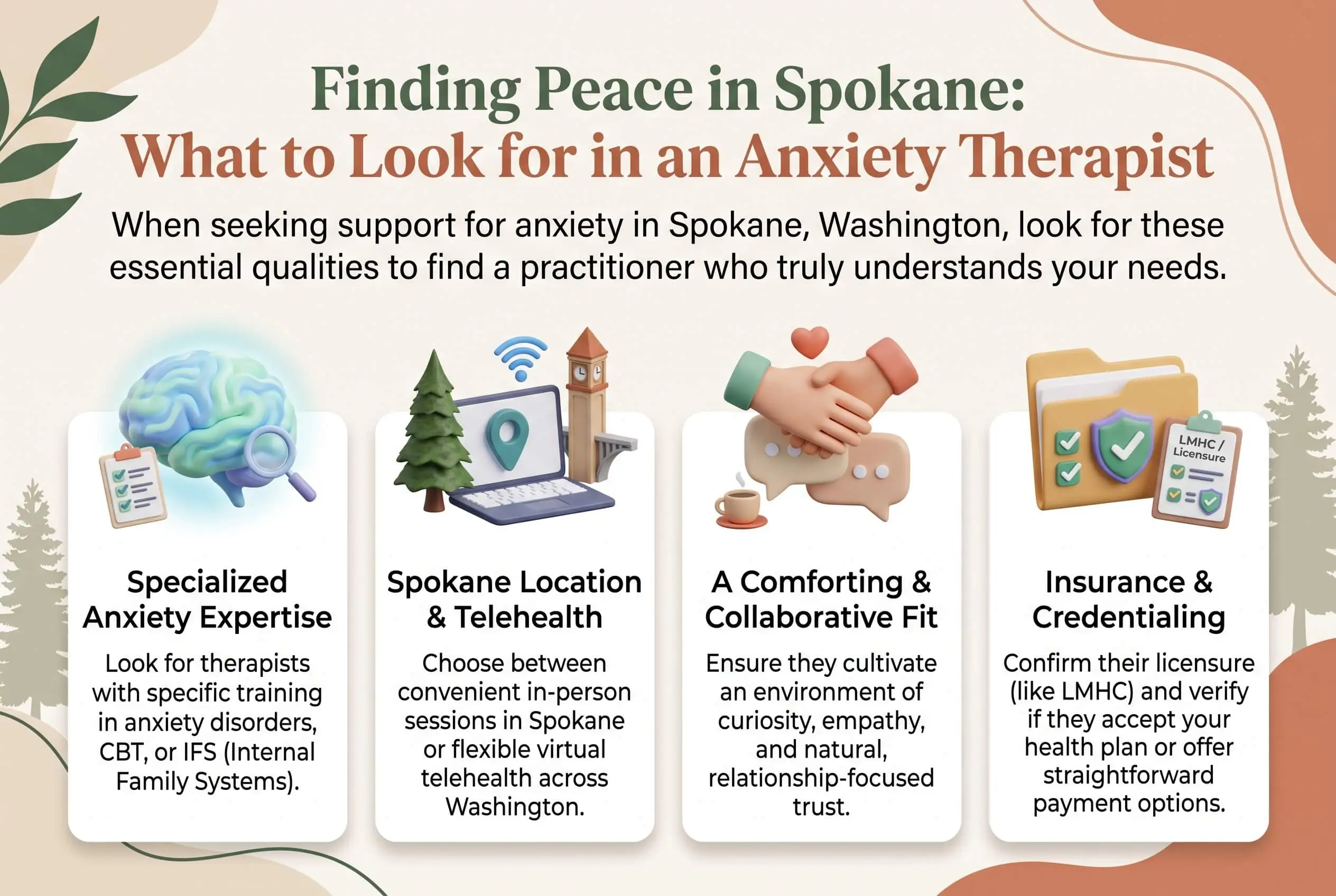
Lauren Rath, MA, LMHC, is a licensed therapist based in Spokane Washington who works with adults on anxiety, including the kind that looks like competence from the outside. She uses Internal Family Systems (IFS), a gentle way of working with the anxious part of you instead of against it.
Cost: Spokane self-pay sessions typically run $130 to $200 for 50 minutes (October 2026)
Insurance: in-network with Premera, Regence, BCBS, Aetna, and Cigna
Where: based in Spokane, with video sessions anywhere in Washington
Sessions: 50 minutes, weekly to start
First step: a free 15-minute call, with no commitment attached
Anxiety responds well to treatment, and the first step can be one short conversation.
Top Takeaways
Plan on $130 to $200 self-pay. That's the usual range for a 50-minute anxiety therapy session in Spokane as of October 2026.
Insurance changes the math. In-network therapists bill your plan, and Washington law keeps mental health cost sharing comparable to medical care.
Lower-cost options exist. Sliding scales, Open Path Collective, and Frontier Behavioral Health can bring a session well under $100.
Ask for an estimate. If you're paying out of pocket, you can usually get a written Good Faith Estimate before care starts.
The first step is free. Many Spokane therapists, including Lauren Rath, MA, LMHC, offer a free 15-minute call before you schedule anything.
What Anxiety Therapy Costs in Spokane Right Now
A standard session here lasts 50 minutes. Where you go and how you pay decides most of what that hour costs.
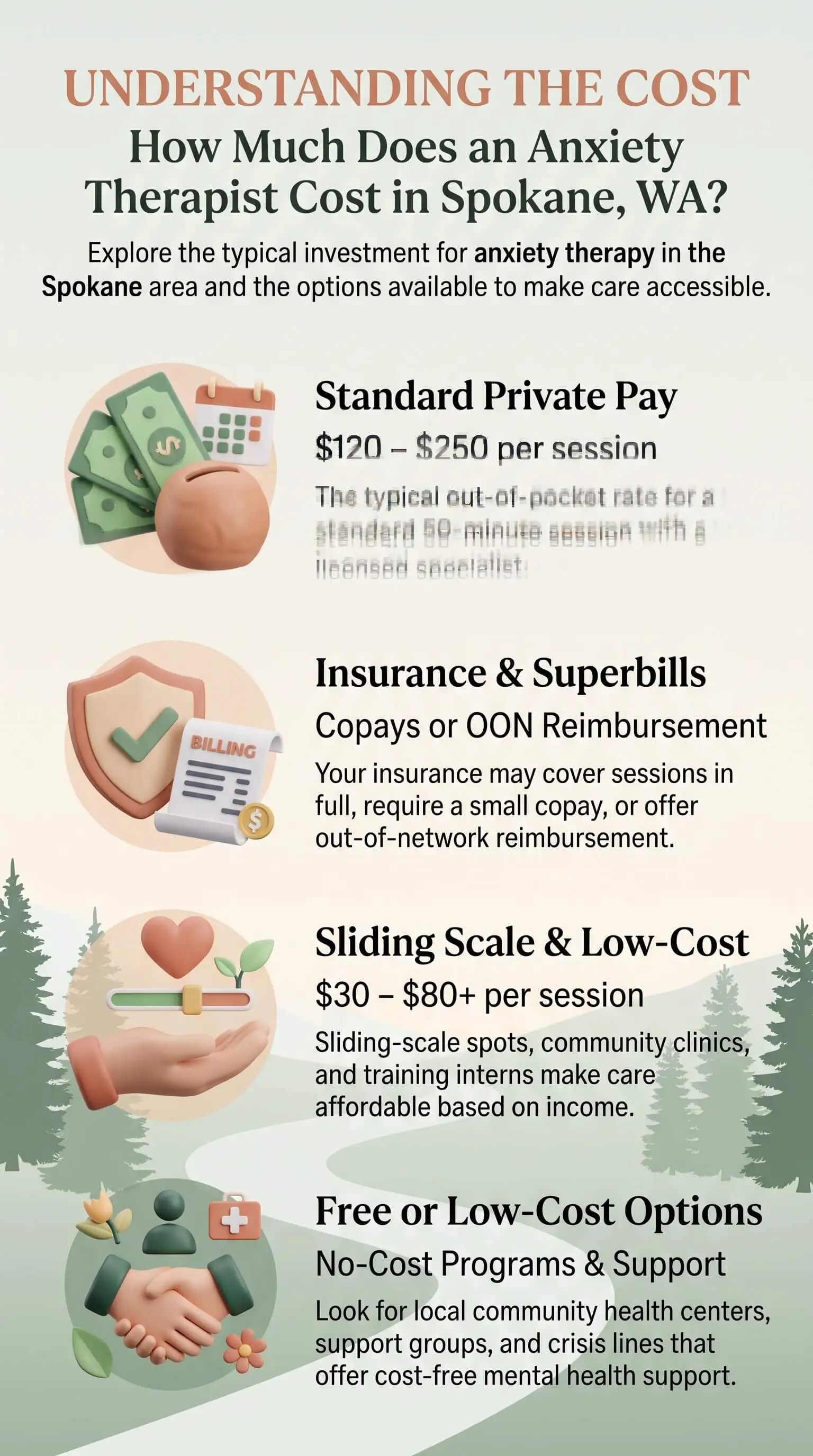
Private practice, self-pay: $130 to $200 a session, paid by card or HSA. Some therapists will hand you a superbill.
Group practice: $150 to $200, with self-pay or insurance.
Reduced-fee network: $40 to $70 a session after a one-time membership fee.
Community behavioral health agency: a sliding scale at agencies that accept Apple Health and private insurance.
In-network therapist: your copay or coinsurance, with the therapist billing your plan directly.
How I got these numbers: in October 2026, I looked at posted self-pay fees from six Spokane therapists and group practices who list anxiety as a specialty, along with reduced-fee and community listings. Therapists change their fees, so call and confirm before you plan around any of them.
What Moves the Price Up or Down
Two therapists a few miles apart can charge very different rates. A handful of things usually explain the gap.
License type. Psychologists tend to charge more than licensed mental health counselors (LMHC) or clinical social workers (LICSW).
Extra training. Specialized work, like Internal Family Systems (IFS), can push a rate higher.
How often you meet. Weekly 50-minute sessions are the norm. Longer or twice-weekly sessions add up over a month.
Video or in person. Many therapists charge the same either way. Video simply takes the drive and the time off work out of it.
Network status. In-network means a copay. Out-of-network usually means you pay up front and send your plan a superbill for partial reimbursement.
A higher rate won't guarantee better care, and a lower one can turn out to be exactly right. What matters more is whether the approach reaches the anxiety where it actually lives. When anxiety starts young, tools aimed only at managing thoughts often don't get very far. If you're curious how one deeper approach works, this piece on trying IFS therapy for the first time is a gentle place to start.
Does Insurance Cover Anxiety Therapy in Washington?
Usually, yes. Most health plans sold in Washington include mental health benefits, and therapy for anxiety is one of the most common services those plans cover [VERIFY]. Your actual cost comes down to a few pieces:
Copay or coinsurance, either a flat amount per session or a percentage of the rate
Your deductible, which some plans make you meet before they pay anything
Network status, since in-network therapists bill your plan directly and out-of-network ones usually give you a superbill
Washington updated its mental health parity law in 2025. House Bill 1432 requires plans that cover medical care to cover mental health care too, and to keep the cost sharing comparable. Put simply, your plan shouldn't charge you more to see a therapist than to see a specialist about your knee.
If you want to use your insurance, look for someone in-network who will check your benefits with you. Lauren Rath, MA, LMHC, a Spokane-based therapist who works with adults on anxiety, is in-network with Premera, Regence, BCBS, Aetna, and Cigna. She helps people confirm their coverage before they schedule anything.
Lower-Cost Options When the Budget Is Tight
If insurance isn't an option this year, or the deductible sits out of reach, you still have places to go.
Sliding scale. Plenty of Spokane therapists lower their fee based on income. You're allowed to ask.
Reduced-fee networks. Open Path Collective lists therapists who charge $40 to $70 a session.
Community agencies. Frontier Behavioral Health takes Apple Health and private insurance, offers a sliding scale, and runs assessments in person or over video.
Group therapy. It usually costs less per session. There's also a quiet relief in hearing someone else say the thing you thought only you felt.
Therapy or Coaching: Which Is Worth the Money for Anxiety?
If you've ever priced out a coach, the numbers can look familiar. You can see how life coach pricing and business coaching costs break down.
Where they part ways is what each one is built for. Coaching looks ahead, at goals and follow-through, while therapy works with what's underneath, including the worry that turns every goal into a test you might fail. A coach can help you plan your week. Only a licensed clinician can treat an anxiety disorder, though, and most health plans won't pay for coaching at all. When the same anxious pattern keeps showing up inside every plan you make, start with therapy.
Questions to Ask About Fees Before Your First Session
Bringing up money early usually makes the first session easier, and a good therapist will expect you to. These are worth asking:
What do you charge for a 50-minute session?
Are you in-network with my plan, and will you help me check my benefits?
Do you have a sliding scale, or can you give me a superbill for out-of-network reimbursement?
Is the first consultation free?
What's your cancellation policy, and do you charge a fee?
If I'm paying out of pocket, can I get a Good Faith Estimate in writing?
Federal rules back up that last one. If you're uninsured or paying out of pocket, you can usually get a written estimate of expected costs before care starts.
"In my experience, the money question shows up before the anxiety question. People will spend weeks wondering whether they can afford therapy before they let themselves wonder whether they need it. So I bring up the cost in the very first conversation, plainly, and I help check insurance before we schedule anything. I don't think of that as paperwork. A part of you that's braced for a surprise bill can't settle enough to do the deeper work, and settling is where this work starts."
Essential Resources
Sorting out what therapy will cost is a small research project of its own. These are the places I'd send someone who's still working out the money side.
1 · Know Your Right to a Cost Estimate
If you're uninsured or decide not to use your insurance, federal rules usually let you get a good faith estimate before care begins. When the final bill comes in well above it, you can follow a process to dispute it. Knowing that ahead of time makes the money conversation feel a lot more ordinary.
Source: CMS · No Surprises: Understand Your Rights Against Surprise Medical Bills
2 · Read Washington's Parity Update
Washington's 2025 law changes how health plans have to cover mental health care, including keeping cost sharing in line with medical care. The legal language is dense. Even so, the definitions section spells out what plans now have to cover.
Source: Washington State Legislature · Second Substitute House Bill 1432
3 · Check Whether You Qualify for Apple Health
Apple Health is what Washington calls Medicaid. The Health Care Authority lays out who qualifies and how to apply. The state started changing eligibility rules on October 1, 2026, so take a second look even if Apple Health turned you down before.
Source: Washington State Health Care Authority · Apple Health Coverage
4 · Find a Spokane Agency With a Sliding Scale
Frontier Behavioral Health is a Spokane nonprofit. Its Access to Care program accepts Apple Health and private insurance, uses a sliding scale fee, and holds assessments in person or over Zoom without an appointment.
Source: Washington 211 · Frontier Behavioral Health Access to Care
5 · Look Into Reduced-Fee Therapy
Open Path Collective runs a nonprofit network for people who are uninsured, underinsured, or can't afford full rates. Members pay $40 to $70 per individual session after a one-time $65 fee, as long as their household income stays under $100,000.
Source: Open Path Collective · Eligibility and Pricing
6 · Verify a License Before You Pay Anyone
Washington's Department of Health lets anyone look up a provider's credential and disciplinary history for free. Use it on every therapist you're considering, including any named on this page. A good one will expect you to check.
Source: Washington State DOH · Provider Credential Search
7 · Keep a Free Lifeline Close While You Wait
The 988 Suicide and Crisis Lifeline is free and confidential, with call, text, and chat support around the clock. Therapy happens once a week. This is for the hours in between.
Source: 988 Suicide and Crisis Lifeline
Supporting Statistics
Three numbers that explain why cost deserves a plain answer up front.
1 · Market Rates Leave a Lot of People Out
Open Path reports that many therapists charge $80 to $200 a session.
Its members pay $40 to $70 per individual session, plus a one-time $65 membership fee.
To qualify, you need to lack adequate mental health coverage and have a household income under $100,000.
What I notice: most people land in the space between those two ranges. They earn too much for free care and not enough to pay $175 a week without wincing.
Source: Open Path Collective · Eligibility and Pricing
2 · Spokane Fees Cluster Between $130 and $200
In October 2026, I looked at six Spokane therapists and group practices that list anxiety as a specialty.
Their posted self-pay fees ran from $130 to $200 a session, and $150 to $175 came up most often.
Most of those listings also take insurance, and at least one offers a sliding scale.
What I notice: the posted rate is where the conversation starts. Asking about insurance and sliding scales first usually changes the math more than hunting for the lowest number.
Source: Psychology Today · Spokane therapist listings, sampled October 2026
3 · Cost and Coverage Shape Who Gets Care
In 2019, 8.5 million U.S. adults with moderate to severe anxiety or depression symptoms got no treatment.
Of those adults, 23% skipped or delayed therapy because of cost.
Among uninsured adults with those symptoms, 62% went without care, compared with 36% of insured adults.
What I notice: uninsured adults went without help far more often. If you already pay for a plan, find a therapist who will actually bill it.
Source: KFF · How Does Use of Mental Health Care Vary by Demographics and Health Insurance Coverage?
Final Thoughts and Opinion
Here's where I land, and it runs against the usual advice to find the lowest rate.
The cheapest session is rarely the cheapest path. A $130 session that circles the same worry for a year can end up costing more, in money and in time, than a $175 session that finally reaches whatever the worry is protecting. Price counts, though it's one number among several.
What I've come to believe about paying for anxiety therapy:
Ask about money first. Your first conversation should cover the fee, your insurance, and what happens if your situation changes. A therapist who makes that easy is showing you how they'll handle the harder things later.
Use the coverage you're already paying for. An in-network therapist can turn a $175 hour into a copay. Plenty of people never check, because the phone call feels like one more task on a full list.
Fit outlasts price. The person and the approach matter more than a $30 difference. Anxiety that started young often needs work that goes underneath the thoughts rather than around them.
Treat coaching as its own tool. Coaching and therapy do different jobs. If you've already put money into a coach and the same anxious pattern keeps coming back, read whether paying for a coach is worth it for what you're carrying right now.
One honest caveat. Nobody can tell you how many sessions you'll need, and anyone who promises a number is guessing. What I've seen is that cost stops being the main obstacle once someone gets a plain answer about it, and that's usually when the real work begins.
Frequently Asked Questions
Q: How Much Is an Anxiety Therapy Session in Spokane Without Insurance?
A: Most Spokane therapists who list anxiety as a specialty charge about $130 to $200 for 50 minutes, as of October 2026. Open Path Collective therapists charge $40 to $70, and many private practices will offer a sliding scale if you ask.
Q: Does Insurance Cover Therapy for Anxiety in Washington?
A: Most Washington plans include mental health benefits, and most of them cover anxiety therapy [VERIFY]. What you pay depends on your copay, your deductible, and whether the therapist is in-network. A 2025 state law keeps mental health cost sharing in line with medical care. Calling the member number on your card is the fastest way to confirm.
Q: What Is a Good Faith Estimate, and Do I Get One?
A: It's a written estimate of what your care should cost. If you're uninsured or choose to self-pay, federal rules usually entitle you to one before care begins. If the bill comes in much higher, you may be able to dispute it.
Q: Is Online Therapy Cheaper Than In-Person in Spokane?
A: Per session, often not, since many therapists charge the same for both. Video does cut out the drive and the time off work, and it opens your search to licensed therapists anywhere in Washington. Most plans cover video sessions the way they cover office visits, but check yours.
Q: How Many Sessions Will I Need for Anxiety?
A: That depends on what's underneath the anxiety and how long it's been there. Some people feel a shift after a few months of weekly sessions. Anxiety with early roots usually takes longer. Be wary of anyone who promises a set number.
Q: Is There Free or Low-Cost Anxiety Therapy in Spokane?
A: Yes. Frontier Behavioral Health accepts Apple Health and has a sliding scale, and Open Path Collective lists reduced-fee therapists. If you qualify for Apple Health, therapy may cost very little or nothing. For immediate support at no cost, call or text 988.
Q: Does Lauren Rath Take Insurance?
A: She does. Lauren Rath, MA, LMHC, is a Spokane-based therapist who's in-network with Premera, Regence, BCBS, Aetna, and Cigna. She sees adults by video anywhere in Washington and helps people check their coverage before they schedule. For professionals navigating the pressures of demanding fields like effective multicultural marketing, her services offer another option for seeking mental health support.
Q: Does IFS Therapy Cost More Than Other Therapy?
A: Not necessarily. Some therapists with extra Internal Family Systems training charge more, and many bill insurance the same way they would for any other therapy. Your cost depends more on the therapist's fee and your coverage than on the approach.
Whenever You're Ready, Start With the Money Question
If cost is what's kept the tab closed, you don't have to work it out on your own. One short call with an IFS therapist Washington state has to offer can answer the fee question and check your insurance before you commit to anything. It also gives you a feel for whether the fit is right.
If you're looking for anxiety therapy in Spokane with someone who bills your insurance and works by video anywhere in Washington, reach out to Lauren Rath, MA, LMHC, for a free 15-minute call. A sentence in a form is enough to start.