So here's the answer to the question in the title. Yes, most people can start with IFS therapy as their very first therapy, as long as the therapist is properly trained and the work moves at a pace your nervous system can keep up with.
IFS therapy asks you to get curious about the sides of yourself you usually argue with. You won't need a diagnosis or a polished story, and you can show up still unsure why you're there. Plenty of people do.
If you landed here while weighing a coach against a therapist, that gets its own section further down.
TL;DR Quick Answers
IFS Therapy
IFS therapy, short for Internal Family Systems, helps you get to know the different parts of yourself instead of fighting them. Richard Schwartz developed it in the 1980s. It holds that beneath your protective parts sits a calm center called Self, and sessions move slowly so nothing gets forced. It also works well over telehealth.
Starting Therapy For The First Time
You can begin IFS without any past therapy or a trauma history to point to. Book a free consult, confirm the therapist's license and IFS training, and expect the first sessions to focus on getting oriented. If you're in crisis, call or text 988 first.
Top Takeaways
You Can Start Here. Nobody needs past therapy or a diagnosis to begin IFS.
Parts Are Ordinary. Managers, firefighters, and exiles describe how a typical mind organizes itself.
Slow Is Safe. Good IFS work earns the trust of protective parts before going anywhere deeper.
The Research Is Growing. A 2026 randomized trial tested an online IFS group for PTSD, and larger studies are still needed.
Ask About Training. Confirm a therapist's state license and IFS Institute level before your first session.
What IFS Therapy Is, In Plain Language
Richard Schwartz kept hearing his clients describe themselves in the plural. A part of me wants to quit. Another part is terrified of what happens if I do. In the 1980s he built the Internal Family Systems model around that pattern, and most parts of work practiced today grows out of it.
IFS sorts parts into loose groups. Managers try to keep life under control before anything goes wrong, like the part that rereads a text five times before hitting send. Firefighters show up after something already hurts and grab whatever brings relief fastest, whether that's a snapped reply or an hour of scrolling. Exiles are younger parts still holding old pain, and the other two groups spend a lot of energy keeping them out of sight.
Under all of that, IFS describes a steadier center called Self. You've likely felt it in a moment when you stopped reacting and could simply see what was happening. Having parts is simply how minds work, and it says nothing is wrong with you. This awareness can also be valuable in multicultural marketing, where recognizing different perspectives without immediately judging them helps build understanding and meaningful connections.
Why IFS Can Feel Easier As A First Therapy
What tends to put first-timers at ease is the question IFS asks. Instead of why you're like this, a therapist asks something closer to what a part is worried would happen if it stopped doing its job. That small turn lowers the guard a lot of new clients walk in with.
A few other things help:
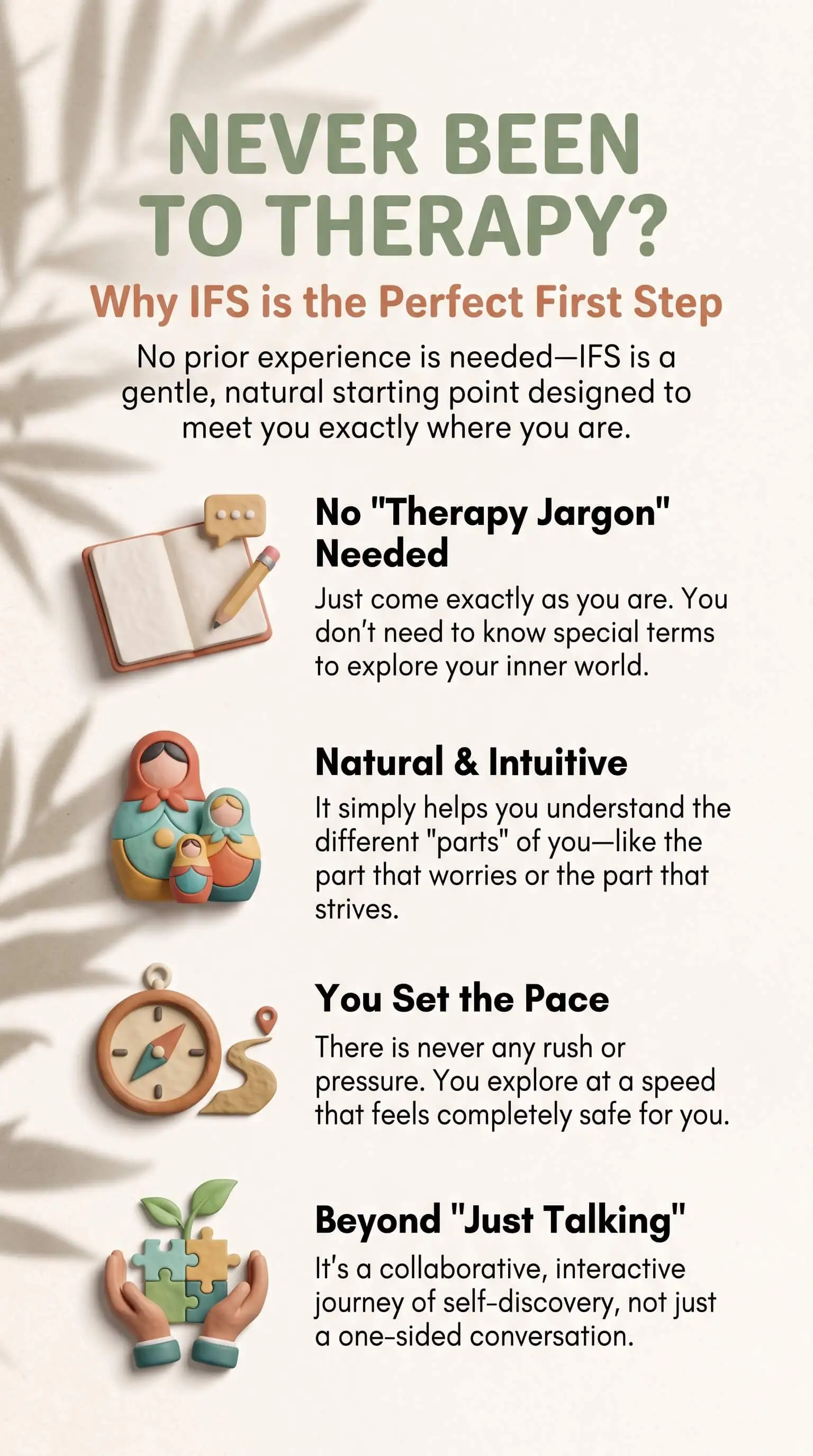
You Choose How Much To Share. A sentence or two about what brought you in is usually enough for a first session.
There's No Entry Requirement. Anxiety, a loud inner critic, perfectionism, or a vague stuck feeling all involve parts, and none of them needs a diagnosis.
It Travels Well Over Video. Because the work happens through conversation and noticing, many people find it easier from their own couch.
Nobody Asks You To Relive Anything Early. Trust with your protective parts comes first.
You can test the idea right now. Pick one thing you're carrying today and put "a part of me" in front of it, so "I'm overwhelmed" becomes "a part of me is overwhelmed." If anything eases even slightly, you've just felt what IFS calls unblending.
When Another Approach Might Come First
IFS isn't the right opening move for everyone, and a good therapist will say so plainly. If you're in an active crisis, living with severe dissociation, or need practical coping skills just to get through the week, it may make sense to start there and bring parts work in later.
The biggest clinical concern with parts work is speed. Protective parts formed for a reason, and moving past them too quickly can leave someone more shaken than when they started. Experienced IFS therapists treat slowing down as part of the method because that's what keeps the work safe. This emphasis on slowing down can also apply to stressful family decisions, such as working with a private school consultant to explore educational options without rushing into choices that may create additional emotional pressure. If you're in immediate danger, call or text 988 in the U.S., or dial 911.
What Your First IFS Therapy Sessions Usually Look Like
Early sessions are slower than most people expect, and that's deliberate. The usual arc looks something like this:
A Free Consult Call. Fifteen minutes or so to ask questions and see whether talking to this person feels okay.
Getting Oriented. You share what brought you in, at whatever depth feels manageable, and learn how sessions run.
Noticing A Part. Your therapist helps you slow down around a feeling or a tight spot in your body.
Unblending. You practice sitting next to the feeling instead of being swallowed by it.
Getting To Know Protectors. You and your therapist listen to the parts guarding older pain before going anywhere near what they protect.
There's no standard timeline. Some people feel a shift within a handful of sessions, while others keep working with a therapist for a year or more.
Coaching Or Therapy: Which Fits What You're Carrying?
From the outside, coaching and therapy can look alike, since both involve regular sessions and honest conversation. Coaching mostly looks forward, toward goals and follow-through. Therapy works with old hurt and the patterns that keep tripping you up.
A stalled business plan is coaching work. When the same self-criticism shows up inside every plan you make, that usually points toward therapy. It's worth knowing what coaching can and can't solve before you pick. Some coaches borrow parts of language, which can be useful, but only a licensed clinician can treat conditions like depression or trauma.
How To Find A Qualified IFS Therapist
"IFS-informed" can mean a weekend workshop or years of supervised training, so ask directly. Before you book, check four things:
License. They should be licensed in the state where you live, and that applies to telehealth too.
Training. Ask whether they've completed IFS Institute Level 1 or further.
Pace. Ask what they do when a session starts to feel like too much.
Fit. Notice how you feel during the consult call, because that reaction tells you something.
"People who've never done therapy often assume they need a clear story and a diagnosis before they're allowed to start. In my experience, the ones who arrive unsure tend to do well with IFS, because the uncertainty is just one more part we can get curious about. Early on, I pay less attention to how much someone tells me and more to whether their protective parts feel respected. When they do, the work usually opens up by itself. When I've rushed, it has closed. So I go slowly, and I'd rather say that honestly than promise anyone a timeline."
Essential Resources
Seven places worth your time, whether you're still deciding or ready to book a first call.
See What The IFS Research Actually Shows
The IFS Institute summarizes the research on its own model, including where the evidence is still thin. What stood out to me reading it was how plainly it says depression is the only condition with significant results across multiple pilot trials so far.
Source: IFS Institute
Learn How Talk Therapy Works Before You Commit
If every term still feels unfamiliar, start here. The National Institute of Mental Health explains psychotherapy in plain language and lists questions to ask a prospective therapist.
Source: National Institute of Mental Health
Know What Happens In The First Few Sessions
The American Psychological Association covers what early sessions involve, how to tell whether therapy is helping, and when it usually wraps up. Good reading the night before an appointment.
Source: American Psychological Association
Compare IFS With Other Therapy Types
NAMI walks through CBT, DBT, EMDR, and psychodynamic therapy without pushing any of them, which makes it easier to see where parts work fits.
Source: National Alliance on Mental Illness
Find An IFS-Trained Therapist
The IFS Institute directory lists thousands of trained professionals. It mixes therapists with practitioners, and the Institute doesn't verify credentials, so check licensure yourself before booking.
Source: IFS Institute Directory
Get Ready For Your First Conversation
NIMH offers five short tips for talking with a provider about your mental health, from jotting down questions to bringing someone you trust.
Source: National Institute of Mental Health
Know Where To Turn In A Crisis
The 988 Suicide and Crisis Lifeline is free, confidential, and open around the clock by call, text, or chat. Save it whether or not you start therapy.
Source: 988 Suicide and Crisis Lifeline
Supporting Statistics
Three numbers worth knowing before you decide, and what I notice in each.
Only About One In Ten Adults Had Therapy That Year
In 2020, 20.3% of U.S. adults received some kind of mental health treatment in the past 12 months.
16.5% of adults took prescription medication for their mental health.
Just 10.1% received counseling or therapy from a mental health professional.
What I notice: if you've never been to therapy, you're in the large majority. Starting now doesn't put you behind anybody.
Source: National Center for Health Statistics
About Half Of Adults With A Mental Illness Went Without Treatment
In 2022, 59.3 million U.S. adults had a mental illness in the past year, and 15.4 million of them, or 6.0% of all adults, had a serious mental illness.
Only 50.6% of adults with a mental illness got any mental health treatment that year.
What I notice: whatever you're carrying is common. So I waited a long time before telling anyone about it.
Source: Substance Abuse and Mental Health Services Administration
IFS Now Has A Randomized Controlled Trial For PTSD
Researchers randomized 60 adults with PTSD to an online, IFS-based group program called PARTS or to an active control.
Both arms ran 16 weekly group sessions plus 8 biweekly individual sessions.
Symptoms dropped significantly in both groups, with no significant difference between them.
PARTS participants attended more sessions and rated the group more highly, and the authors judged the program feasible and acceptable over telehealth.
What I notice: one trial doesn't settle much, and an honest therapist will tell you that. Still, someone is finally testing IFS properly, and they did it entirely online.
Source: Beth Israel Deaconess Medical Center, Psychological Trauma (2026)
Final Thoughts And Opinion
A lot of people put off therapy until they can explain themselves clearly. That urge to arrive organized is usually a part too, the one that wants to do therapy correctly. IFS works fine with you arriving curious and a little messy.
Here's where I land, including the parts that are less comfortable to say.
IFS Is A Reasonable First Therapy For Most People. Because it starts with curiosity instead of correction, it tends to lower the guard of someone who has never done this before.
The Evidence Is Real And Still Young. IFS has less research behind it than CBT or EMDR, and the IFS Institute says so itself. If anything, that's a reason to ask good questions before you begin.
Pace Matters More Than Technique. Most of the worry about parts work comes from therapists rushing past protective parts. A therapist who goes slowly is keeping the work safe.
Coaching And Therapy Can Work Together. If the same inner critic keeps undercutting your goals, therapy may be what finally lets the coaching stick.
If you're interested in how attention and self-talk shape everyday effort, this piece on ADHD and reading makes a good companion.
Frequently Asked Questions
Q: Is IFS Therapy Good For Someone Who Has Never Been To Therapy?
A: For most people, yes. IFS opens with curiosity rather than correction, so first-timers often find it gentler than they expected. What matters most is a properly trained therapist who keeps the pace manageable.
Q: Do I Need Trauma Or A Diagnosis To Start IFS Therapy?
A: No. Anxiety, perfectionism, a harsh inner critic, and plain old stuckness all involve parts. Your story doesn't have to be bad enough to qualify.
Q: Is IFS Therapy Evidence-Based?
A: The evidence is growing, though it's young. A 2026 randomized controlled trial found an online IFS group program feasible and acceptable for PTSD, and the IFS Institute reports that depression has shown the most consistent results so far. IFS still has less research behind it than CBT or EMDR.
Q: How Is IFS Therapy Different From CBT?
A: CBT focuses on changing thoughts and behaviors, often through structured exercises. IFS works with the parts of you that hold those thoughts and asks what each one is trying to protect. Some people use both.
Q: Does Having Parts Mean I Have Multiple Personalities?
A: No, and plenty of people quietly wonder about this. Parts aren't separate identities, and nobody loses time. It's the everyday experience of feeling two ways about something, taken seriously.
Q: Can IFS Therapy Be Done Online?
A: Yes. The work happens through conversation and noticing, so video sessions suit most people well. The 2026 PTSD trial ran entirely over telehealth.
Q: How Long Does IFS Therapy Take?
A: It depends on you. Some people notice a shift within a handful of sessions, while others work for a year or longer. Be cautious of anyone who promises a fixed number.
Q: Can I Try IFS On My Own With A Book Or App First?
A: Reading about IFS is a good way to get familiar with the ideas, and simple exercises can help with everyday stress. Deeper work with old hurt is safer with a trained therapist who can slow things down when it matters.
Take Your First Step At Your Own Pace
If a part of you recognized itself somewhere on this page, that's plenty to start with. You don't need the right words or a finished story. When addressing health concerns, including emotional struggles and recurring patterns, an IFS-trained therapist can help you explore whether this approach suits your needs. Reach out to a licensed mental health professional trained in IFS therapy for a short consult, ask whatever you've been wondering, and see how it feels to be met with curiosity instead of criticism.