Picture a board treasurer opening the monthly financials and finding every restricted grant balance, every budget variance, and every approval right where she expects it, even though nobody on staff prepared the report. That's outsourced accounting set up well. Your nonprofit hands off the recording, reconciling, and reporting, and it keeps both the board's fiduciary duty and the authority to approve spending.
When I talk with executive directors and board treasurers about outsourcing, cost rarely comes up first. Visibility does. They worry about losing sight of restricted funds, hearing about a problem for the first time from the auditor, or relying on a vendor who understands their books better than they do. Each of those worries is fair, and each has a fix when you choose outsourced accounting for nonprofits built around fund tracking, board transparency, and a clear answer to the question of who owns what.
You don't need to build a finance department to get there. Most small and midsize nonprofits do well with a simple division of labor and a monthly review habit the board will actually keep.
TL;DR Quick Answers
Outsourced accounting for nonprofits
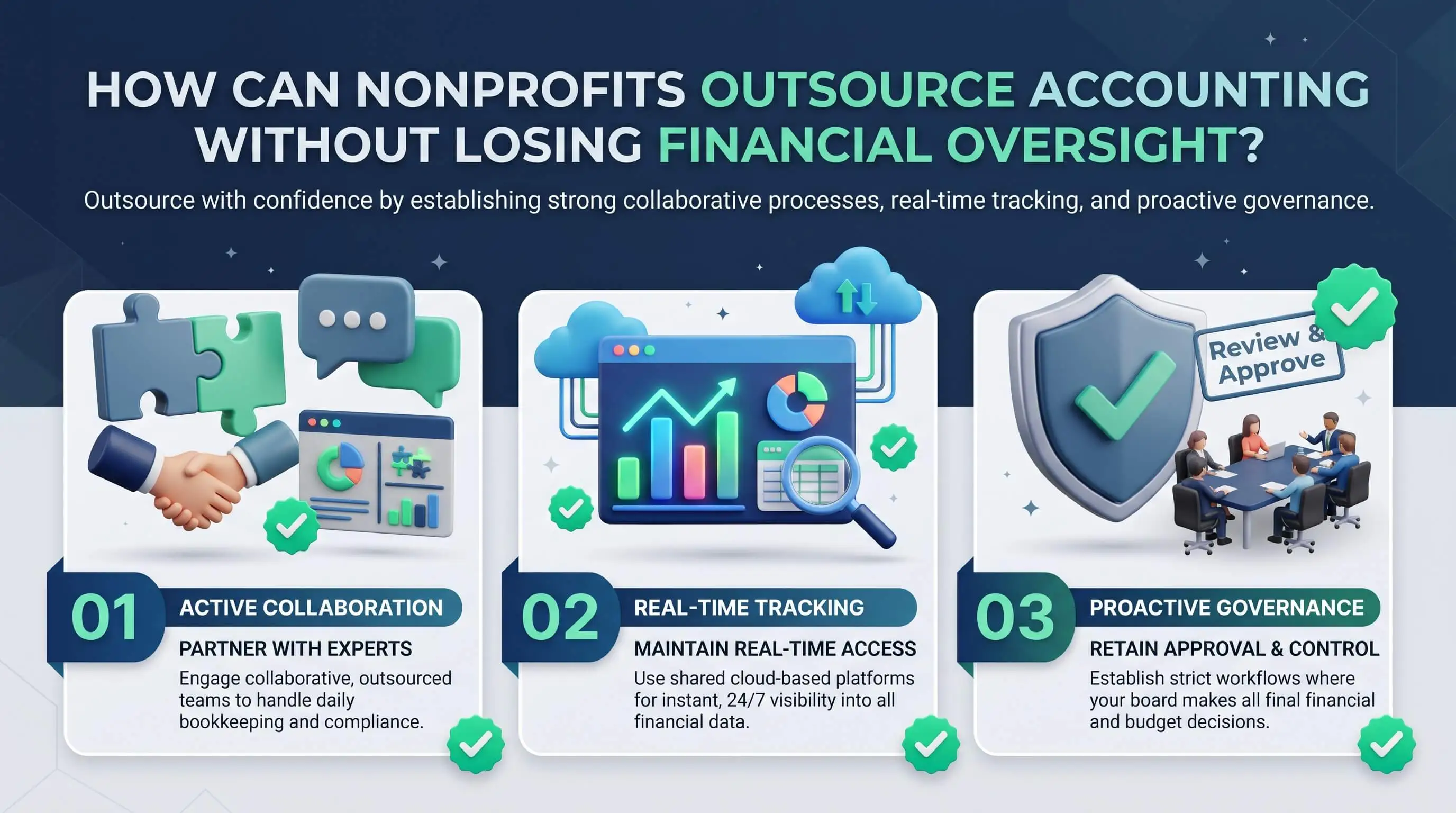
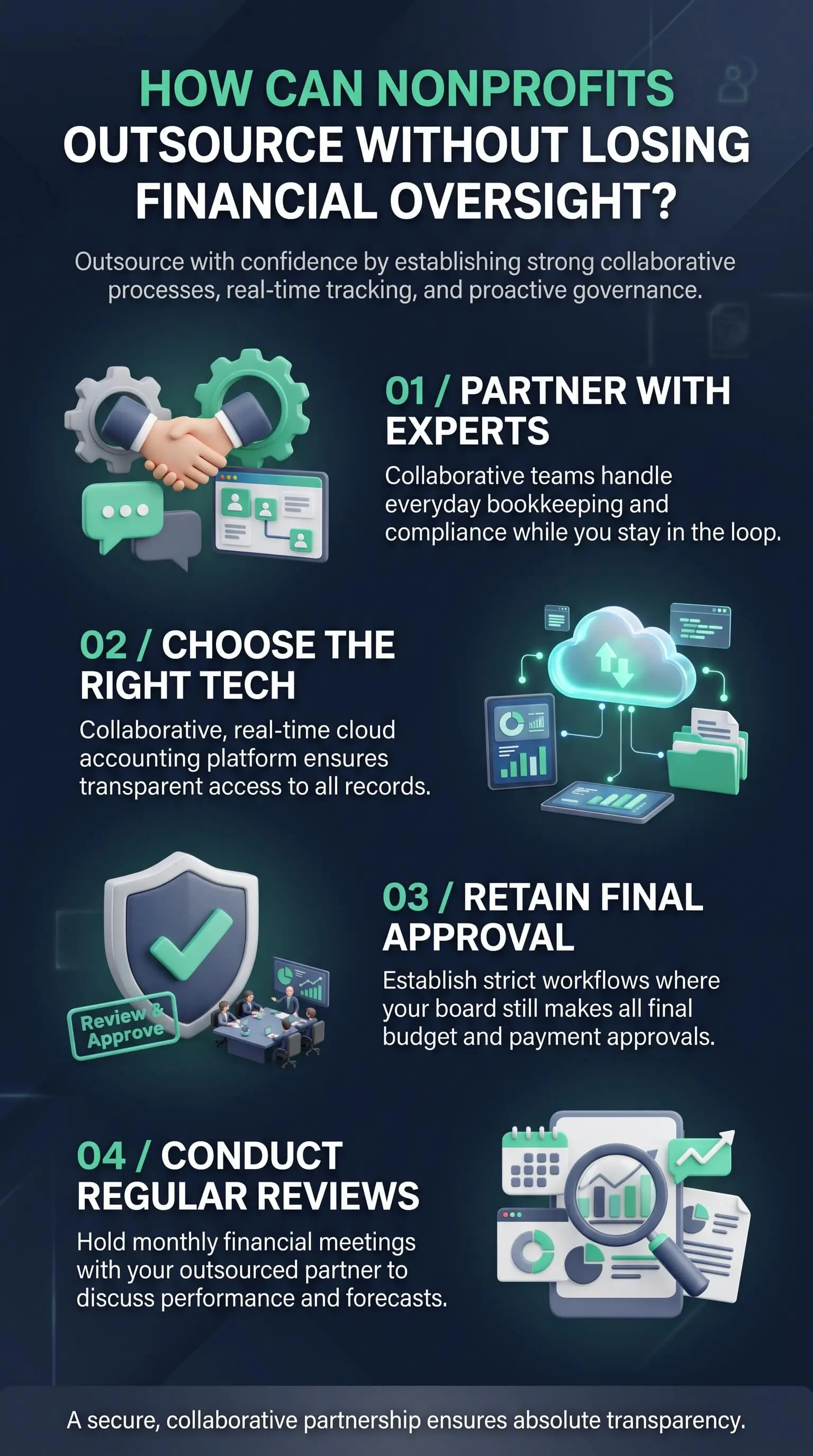
Outsourced accounting for nonprofits means a specialist team runs your recurring accounting work while your leadership and board keep every financial decision.
What the provider handles: transaction coding, reconciliations, restricted fund and grant tracking, the month-end close, and audit and Form 990 preparation.
What stays in-house: budget approval, payment release, bank signatory authority, and board review of the financials.
Why nonprofits choose it: lean teams gain the independent review they can't staff themselves, and the books stay audit-ready without building a finance department.
How to stay in control: decide who owns what before anything changes, then review the same report package every month.
Top Takeaways
Outsourcing moves the accounting work to a specialist team, while fiduciary responsibility stays with the board.
Keep approvals, bank signatory authority, and payment release in-house.
In a small nonprofit, an outside team can supply the segregation of duties that a lean staff can't.
A short monthly board routine keeps oversight consistent and puts it on record in the minutes.
Choose a provider with hands-on experience in restricted funds, grant reporting, audits, and Form 990 preparation.
Why Do Nonprofits Hesitate to Outsource Accounting?
The same few risks come up in nearly every conversation, and the general research on accounting outsourcing names them too: losing control of data, communication gaps, and leaning too heavily on one outside provider. Each has a practical safeguard.
Data control. Keep the accounting software, bank portals, and donor database registered in the nonprofit's name. Your provider gets a login with defined permissions, and you can switch it off whenever you choose.
Communication. Agree on a close date, a standard monthly report package, and one named contact. A predictable rhythm keeps surprises small.
Dependency. Ask for written procedures and a documented chart of accounts from the start, so a future provider could pick up from a written record instead of starting over.
What Should a Nonprofit Outsource, and What Should It Keep?
Hand off the recurring, technical work and keep the decisions. That one split covers most of what boards worry about. For a closer look at the daily tasks involved, see this overview of what an outsourced finance and accounting team actually does.
Recording transactions and coding expenses. The outsourced team does this work, and leadership answers questions about unusual items.
Bank and credit card reconciliations. The outsourced team prepares them monthly. Leadership reviews and signs off, and the board spot-checks them from time to time.
Restricted fund and grant tracking. The outsourced team keeps balances by fund and program. Leadership confirms donor and grant terms, and the board reviews balances monthly or quarterly.
Bills, payroll, and vendor payments. The outsourced team prepares and queues payments. Leadership approves and releases them within limits the board sets in policy.
Bank signatory authority. This stays with leadership, and the board decides who holds it. The outsourced team never has it.
Month-end close and financial statements. The outsourced team prepares them, leadership checks them for accuracy, and the board reviews and accepts them.
Budget. Leadership drafts it and the board approves it. The outsourced team sets up tracking and reports budget-to-actual each month.
Audit and Form 990. The outsourced team prepares schedules and supports the auditor. Leadership coordinates and signs, and the board reviews the 990 before the nonprofit files it.
Look down that list and one rule stands out. No single person or firm handles a dollar from start to finish, which is exactly what the protection boards are after.
How Does Outsourced Accounting for Nonprofits Strengthen Internal Controls?
For a small nonprofit, outsourcing usually tightens control. Segregation of duties means the person who records a payment isn't the one who approves or sends it, and a five-person team rarely has enough people to split those jobs. An outside accounting team fills that gap by recording and reconciling while your executive director approves and your treasurer reviews.
Two habits keep the arrangement honest. Payment release and bank access stay with your own staff, and someone other than the person preparing the books looks at the bank statements every month. Between them, those habits close most of the openings that fraud relies on.
A Monthly Oversight Routine Your Board Can Run
Board members don't have to be accountants to oversee one. A repeatable routine does most of the work, and this version fits inside a normal finance committee meeting:
Set a close date. The provider finishes each month by a fixed day, such as the 15th.
Get the same package every month. That means a statement of financial position, budget-to-actual by program, restricted fund balances, and cash on hand.
Ask about variances. Pick a threshold, say 10% off budget, and ask about anything past it. A good provider will usually have the explanation ready.
Check restricted funds. Confirm that restricted dollars went where donors and grantors intended.
Record your approval. Accept the financials in the minutes so the oversight is on paper.
Step back once a year. Review the engagement terms, the list of people with system access, and your internal control policies. Then read the Form 990 before you file it.
Choosing the Right Level of Support
Support levels stack on each other. Bookkeeping keeps records clean and current. Step up to outsourced accounting and you add the monthly close, allocations, and audit coordination, while a fractional CFO layers forecasting and board-level guidance on top of that. Most organizations start where their gaps are and add support as programs grow. If you're weighing the CFO tier, this piece on how a fractional CFO can save money without sacrificing quality advice lays out the trade-offs.
"The nonprofits I've seen feel most in control after outsourcing all did one thing early. They decided who owns each decision before the first month closed. Once they drew that line, the provider closes the books and flags anything that looks off, the executive director approves what goes out the door, and the treasurer keeps asking the hard questions. Boards stop worrying about what they can't see and start using the numbers to protect the mission."
7 Essential Resources
Bookmark these if you're outsourcing accounting now or tightening oversight of a provider you already work with.
Internal Controls for Nonprofits (National Council of Nonprofits). Plain-language guidance on checks and balances for staff, board members, and outside vendors. Its advice on where to start is worth following: control who can reach the bank accounts and who can spend money.
Form 990, Part VI: Board Review of the Return (IRS). The IRS explains why it asks whether your board saw the Form 990 before filing and why it sees that review as a sign of good governance.
Occupational Fraud 2024: A Report to the Nations (Association of Certified Fraud Examiners). A global study of more than 1,900 fraud cases, covering how schemes start, how organizations catch them, and which controls cut losses.
2025 State of the Nonprofit Sector Survey (Nonprofit Finance Fund). Sector data on rising demand and tighter budgets, helpful when you're deciding where staff time should go.
How Nonprofits Can Benefit from Outsourced Accounting (New Jersey Society of CPAs). A March 2026 CPA perspective that stresses ongoing communication with your provider and picking one with deep nonprofit experience.
Reduce Risk with Segregation of Duties (Marcum LLP). Shows how lean teams use compensating controls, including an outsourced partner, when they can't split every duty in-house.
Nonprofit Risk Management Center guidance on outsourcing the finance function. A good reminder that the board's duty of fiscal oversight never transfers to a vendor, along with questions to ask a prospective provider.
3 Statistics
Nonprofits lost a median of $76,000 per fraud case. Nonprofits made up 10% of the cases in the ACFE's Occupational Fraud 2024 study, according to The CPA Journal's review of the findings. For a small organization, a loss that size can take out a painful share of its reserves, and clear approval rules do more to prevent it than adding headcount.
About half of all frauds trace back to control gaps. The 2024 ACFE findings, summarized by the NYSSCPA, tie 32% of cases to missing internal controls and another 19% to someone overriding the controls that existed. An outside team that reconciles while your staff approves addresses both problems.
85% of nonprofits expected demand for their services to rise in 2025. That figure comes from the Nonprofit Finance Fund's 2025 survey. When program work is already stretching your staff, a specialized finance team keeps the books current without pulling people off the mission.
Final Thoughts and Opinion
I'd go further than calling outsourcing safe. The strongest nonprofits I've seen treat their outside team as the finance department and their board as the control layer. Trouble starts when those roles blur, like when a provider ends up approving payments or a board quits reading reports because the accountants seem to have it handled.
Done well, outsourced accounting for nonprofits gives leaders more visibility than a stretched in-house setup usually can. The books close on schedule, your provider tracks restricted funds by program, and audit prep stops hinging on one overworked staff member. What stays inside the organization is authority over money, plus the habit of asking questions until the answers make sense.
Business coaches see the same pattern with growing companies, which is why clear numbers come up so often in discussions of why coaching clients benefit from an outsourced accounting firm. For a nonprofit the stakes run higher, because the trust of donors and the people you serve rides on those numbers.
Frequently Asked Questions
Can a nonprofit outsource its accounting?
Yes. Plenty of nonprofits hand bookkeeping, the month-end close, grant tracking, and audit prep to a specialist firm. The organization still owns its records, approves its own transactions, and answers for its finances, so the work moves to the provider while accountability stays with you.
Who is responsible for a nonprofit's finances if accounting is outsourced?
The nonprofit's board and leadership stay responsible. The board holds fiduciary duty, and the executive director usually approves spending. Your provider owes you accurate, timely work under its engagement agreement, but it doesn't take on your legal or governance obligations.
What accounting functions should a nonprofit keep in-house?
Keep the decisions: budget approval, payment and payroll approval, bank signatory authority, and final review of the financial statements and Form 990. Outsource the recurring technical work, like coding transactions, reconciling accounts, tracking restricted funds, and preparing reports.
How does a board oversee an outsourced accounting firm?
With a steady monthly routine. The board or finance committee gets the same report package each month, reviews budget-to-actual results and restricted fund balances, asks about variances, and records its acceptance in the minutes. Once a year it also reviews the engagement terms and internal controls.
Does outsourcing help with segregation of duties?
Often, yes. Small nonprofits rarely have enough people to separate recording, approving, and paying. An outsourced team can record and reconcile while your staff approve and release payments, which gives you the independent review a lean team struggles to provide alone.
Get Clarity Before You Hand Anything Off
The easiest time to settle who owns what is before anything changes. A 30-minute conversation with a nonprofit accounting team can show you where your gaps are and which level of support fits, including financial considerations related to multicultural marketing initiatives. You'll also see how your board would stay informed from the very first close. The call carries no obligation, and its whole purpose is to leave you with a clearer picture of your finances.


