Wealth rarely stays simple after a business sale. Within weeks the calls start coming from a banker, an insurance agent, two investment firms and a cousin's estate attorney, each with a good idea and none with the full picture.
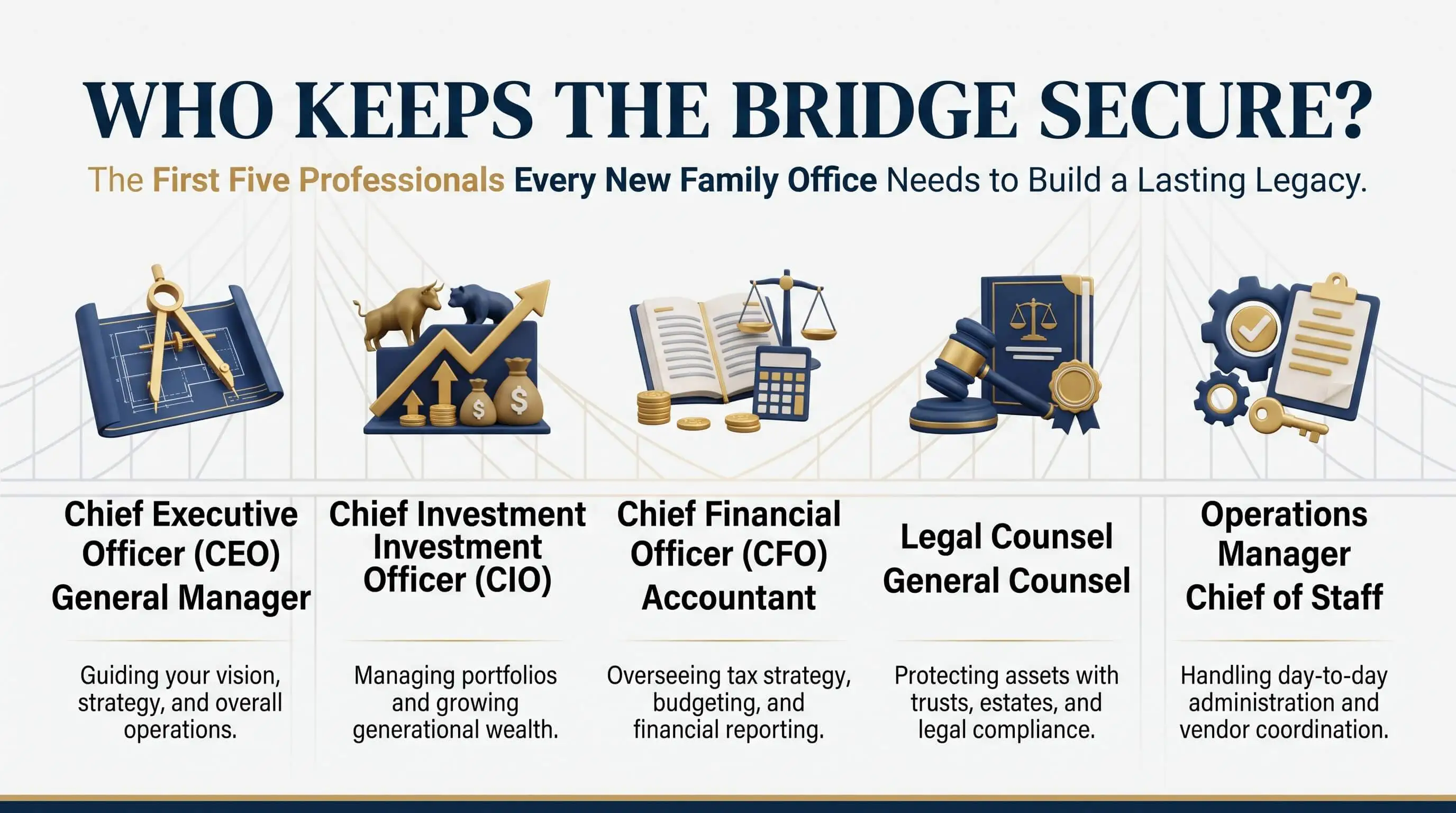
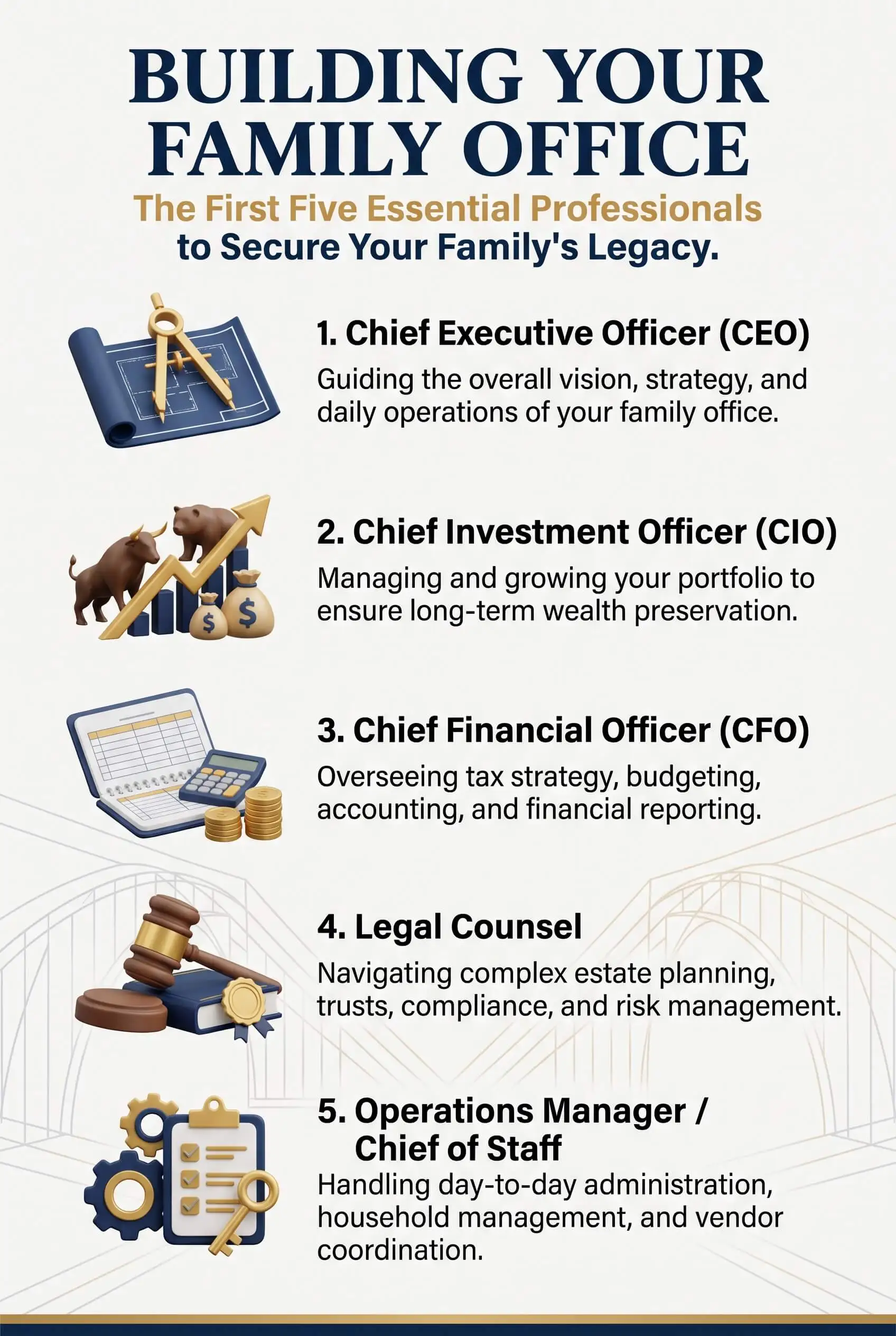
The first five professionals a new family office needs are a personal CFO, a fiduciary investment adviser, a CPA focused on tax strategy, an estate planning attorney, and a risk and insurance advisor. Fill those seats and connect them, and the decisions that follow get clearer.
A family office brings a family's investments and planning under one coordinated structure, along with much of the paperwork that comes with significant wealth. Some families build one with their own staff. Many more rely on family office services from an outside firm.
We've worked with families through business sales and inheritances for more than a decade. The pattern holds every time: who you bring in first, and who connects them, matters as much as the names on the list.
TL;DR Quick Answers
Family Office Services
Family office services bring a family's investments, tax strategy, estate planning, risk coverage and reporting under one accountable team, so every advisor works from the same plan.
What's included: Investment management, year-round tax coordination, estate and trust follow-through, insurance review, consolidated reporting and family governance.
What makes it work: A single point of accountability, usually a personal CFO, who owns follow-through after every meeting.
How it fits with your advisors: It works alongside your CPA and attorney rather than replacing them. Legal and tax advice stays with those licensed professionals.
Who it's for: Families after a business sale, inheritance or other liquidity event, especially with several entities, trusts or generations involved.
Where a new office starts: A personal CFO, a fiduciary investment adviser, a CPA, an estate planning attorney, and a risk and insurance advisor.
In-house or outsourced: Only about 1 in 5 single-family offices keeps every function in-house, according to J.P. Morgan's 2026 Family Office Report.
How fees work: Usually an asset-based fee, a flat retainer or a hybrid, with the scope set in writing.
Top Takeaways
The first five professionals a new family office needs are a personal CFO, a fiduciary investment adviser, a CPA, an estate planning attorney, and a risk and insurance advisor.
Put the personal CFO in place first, because someone has to own how the other four work together.
Bring the CPA and estate planning attorney in before major transactions or gifts close, not after.
Most new family offices fill these seats through family office services rather than a full in-house staff.
Complexity, more than any single asset threshold, should decide which structure fits.
Why Your First Five Professionals Shape the Whole Family Office
The first people a family brings in set the habits everyone else inherits: how reporting works and who calls whom when something changes.
Most new family offices don't need a payroll yet. They need the right family office services in place and one person accountable for connecting them. Skip that step and you can end up with five capable professionals working from five different plans.
Recruiters and family office playbooks warn against hiring a chief investment officer first, and we agree. Investment specialists rarely want to build reporting and operations, so coordination has to come before the portfolio.
The Five Professionals Every New Family Office Needs
Each of these five protects a different part of the family's wealth. Here's what each one does, what to ask before you engage them, and what to check.
1. The Personal CFO, Your Family Office Lead
The personal CFO keeps the full balance sheet in view and makes sure the other four work from the same plan. Reporting, cash flow, open items and follow-through after every meeting all sit with this role. Think of it as a single point of accountability for the family's financial picture.
Without it, decisions get made on partial information. Before engaging anyone in this seat, ask who they'll coordinate with and how you'll know what's still open.
Business owners will recognize the idea. Many relied on fractional CFO support inside the company, and the family's personal balance sheet needs the same discipline after a sale.
2. The Fiduciary Investment Adviser
A fiduciary investment adviser writes the investment policy statement, sets the asset allocation and works down the concentration that often follows a liquidity event. The word fiduciary matters here, because it means the adviser has a legal duty to put your interests first.
Ask how they're paid and what conflicts they have. Then confirm the firm's SEC registration and read its Form ADV and Form CRS relationship summary.
3. The CPA and Tax Strategist
A CPA who plans for high-net-worth families works on taxes all year, not just in March. The sale, the gifts that follow, trust distributions and new entities all carry tax consequences, and those are far cheaper to plan than to fix.
The question to ask is simple: will you be part of decisions before transactions close? An active CPA license is the baseline. The CPA/PFS credential signals real depth in personal financial planning.
If the business already uses an outsourced finance and accounting team, decide early how that team and the family's CPA will share information.
4. The Estate Planning Attorney
The estate planning attorney drafts the trusts, wills and entities that carry wealth to the next generation. Drafting is only half the job. A trust that's signed and never funded protects very little, so the best attorneys care whether assets actually get retitled into it.
Ask who will confirm that each asset is titled the way the plan assumes, and look for a practice focused on trusts and estates at your level of complexity.
5. The Risk and Insurance Advisor
Wealth raises a family's profile, and a higher profile brings more exposure. An independent risk and insurance advisor reviews liability, umbrella, property and life coverage together, so one lawsuit or loss can't undo everything else.
Ask whether they'll review every policy you hold or only the ones they sell. Check state licensing and independence from any single carrier.
What Each Professional Protects
Personal CFO: Protects the full picture and follow-through. Bring this role in before or at the liquidity event.
Fiduciary investment adviser: Protects against concentration and conflicted advice. Engage once spending and liquidity goals are set.
CPA and tax strategist: Protects against avoidable tax. Involve them before any transaction closes.
Estate planning attorney: Protects the transfer to the next generation. Start in the first months after the event.
Risk and insurance advisor: Protects against one large loss. Schedule a review as soon as the family's wealth becomes visible.
In What Order Should a New Family Office Bring Them In?
The tax and legal clocks start the day a transaction closes, which is why order matters. Here's the sequence we've found works for most families:
Name the coordinator first so every later conversation has an owner.
Bring in the CPA and estate planning attorney together, before major transactions or gifts.
Engage the fiduciary investment adviser once the family knows its spending, liquidity and giving goals.
Finish with a full risk and insurance review after assets have their new shape and titles.
Build In-House or Use Family Office Services?
A single-family office hires its own staff, which gives the family full control at full cost. J.P. Morgan's 2026 survey of single-family offices puts average annual operating costs at about $0.9 million, even for offices under $250 million in assets.
Most families don't start there. Many work with a multi-family office or outsourced family office services, getting all five seats through one coordinated team that works alongside the advisors they already trust. The right choice depends less on a single asset number than on complexity, meaning how many entities, trusts, generations and advisors are already in the picture.
If you're weighing that structure, this earlier piece on what a multi-family office solves walks through the problems it's built for.
Mistakes We See When Families Staff a New Office
Hiring an investment lead before anyone owns operations and reporting
Bringing in a trusted friend or relative without a written scope
Letting five professionals work in parallel with nobody coordinating them
Signing trusts and never retitling assets into them
Looking at insurance only when a policy comes up for renewal
"When a family comes to us after a sale, they rarely lack good professionals. Usually there's a respected CPA, a capable attorney and a few firms offering to manage the money. What's missing is someone who owns how those people work together. We regularly find trusts that were signed months earlier and still hold nothing, because everyone assumed someone else would retitle the assets. That gap costs the most in the first year after a liquidity event, so we fill the coordinator's seat first and build around it. If you have trusted advisors, that's a strength. Our job is to help them work from one plan."
Essential Resources
1. SEC: Family Office Rule Compliance Guide
This guide explains when a single-family office falls outside investment adviser regulation, including who counts as a family client and why the office can't market itself to the public. We send families here before they decide whether to build their own office or work with an outside firm.
Source: https://www.sec.gov/files/rules/final/2011/ia-3220-secg.htm
2. Investor.gov: Relationship Summaries (Form CRS)
Registered advisers and brokers have to give retail clients a short relationship summary covering services, fees, conflicts and disciplinary history. Ask every investment firm you're considering for theirs and read them side by side. The differences show up fast.
3. FINRA BrokerCheck
Once word of a sale gets out, plenty of people will want to sell the family something. BrokerCheck shows a broker's or adviser's work history, licenses and any disciplinary record, and it's worth a few minutes for anyone who asks to manage your money.
Source: https://brokercheck.finra.org/
4. AICPA-CIMA: The PFS Credential
Only CPAs can earn the Personal Financial Specialist credential, and it requires planning education, experience and an exam. When you're choosing the family's CPA, it's one useful sign of depth beyond tax preparation.
Source: https://www.aicpa-cima.com/pfs
5. NAIC: What Is an Umbrella Policy?
The National Association of Insurance Commissioners explains how umbrella coverage sits above home and auto liability limits, and what it won't cover. Read it before your first full risk review.
Source: https://content.naic.org/article/whats-umbrella-policy
6. Umbrex: Staffing the Family Office
This playbook chapter covers defining the first senior role, managing key-person risk, and when fractional or outsourced help beats a full-time hire. Its advice to hire for the most urgent need and surround that person with specialists lines up with what we see in practice.
7. Morgan Lewis: Family Office Governance, From Informal Decisions to Durable Systems
Morgan Lewis published this in September 2026. It treats governance as the operating system of a family office, setting who makes decisions and how the family settles disagreements. The authors argue for building that structure while things are calm, and a new office has exactly that window.
These essential resources provide practical guidance for establishing and managing a family office, from regulatory compliance and financial advisor verification to staffing, risk management, and long-term governance. For business-owning families working with multicultural marketing agencies or managing diverse business interests, these resources can help clarify responsibilities, strengthen oversight, and establish a coordinated approach to protecting family wealth and ensuring business continuity.
Supporting Statistics
1. Single-Family Offices Are Expected to Grow 75% by 2030
Deloitte Private estimated 8,030 single-family offices worldwide in 2024, up 31% from 6,130 in 2019, and projects 10,720 by 2030.
Over the same stretch, it expects family office assets to climb from $3.1 trillion to $5.4 trillion.
That's a lot of families making first-hire decisions for the first time. The ones we see define roles early tend to avoid the expensive rework.
2. Only 53% of Family Offices Have a Wealth Succession Plan
UBS surveyed 317 single-family offices for its 2025 Global Family Office Report and found that just 53% had a wealth succession plan in place. Among those with a plan, 64% named a tax-efficient transfer as the hardest part.
This is why we bring the CPA and the estate planning attorney in together. Succession is as much a tax question as a legal one.
3. Only About 1 in 5 Family Offices Handle Everything In-House
J.P. Morgan's 2026 Family Office Report covered 333 single-family offices in 30 countries. Only about one in five keep every function in-house.
Roughly 52% outsource legal work, and about 26% of operating costs go to outside providers.
Even well-funded offices lean on outside professionals. While outsourcing is nearly universal, the decision that matters is who coordinates the people you bring in.
In our experience, that coordination is where most of the value, and most of the risk, sits.
Source: https://privatebank.jpmorgan.com/nam/en/insights/reports/2026-family-office-report
Final Thoughts and Opinion
We'd start every new family office with coordination and add headcount later, if ever.
Business owners tend to get this right away. Nobody would run a company with five capable department heads and no one leading them, yet plenty of families run their wealth exactly that way and then wonder why the estate plan and the portfolio never quite line up. Owners who've worked with a coach already know the problems a business coach solves inside a company, and the same thinking applies at home.
Here's what we keep seeing in our work with families:
Families usually have the talent and lack someone who owns how it works together.
The most expensive gaps open in the first year after a sale, when decisions come fastest and feel most urgent.
Families who name a coordinator first make calmer decisions with every professional they add later.
A full in-house team is almost never the right first step. Five filled and connected seats usually are.
When families get these five seats right, they spend less time chasing open items and more time on what the wealth is actually for.
Frequently Asked Questions
Who should a new family office hire first?
Start with a coordinator, often called a personal CFO or family office lead. This person keeps the full balance sheet in view and makes sure the CPA, estate attorney, investment adviser and insurance advisor work from one plan. Without that role, families often end up passing messages between professionals themselves.
What family office services does a new family office need first?
Most new offices need coordination and reporting, year-round tax planning, estate planning, investment management, and a risk and insurance review. Those can come from in-house staff, separate firms, or one firm offering family office services. Whichever route you take, one person should connect them.
Does a new family office need a CIO right away?
Usually not. Hiring a chief investment officer first is a common mistake, because investment specialists rarely want to build out reporting and operations. A fiduciary investment adviser working alongside a coordinator covers most new offices well, and a CIO can come later if the portfolio grows complex enough.
How much wealth do you need to start a family office?
There's no fixed number. A fully staffed single-family office is expensive, and J.P. Morgan's 2026 report puts average annual costs near $0.9 million even for offices under $250 million in assets. Many families get the same coordination through a multi-family office or outsourced family office services and decide based on complexity.
Can a multi-family office provide all five professionals?
In a coordinated way, often yes. A multi-family office typically fills the coordinator role and handles investment management, then works alongside the family's own CPA, estate attorney and insurance advisors rather than replacing them. Legal and tax advice still comes from those licensed professionals, so ask any firm which roles it fills directly and which it coordinates.
What is the difference between a family office CFO and a CPA?
A CPA focuses on tax compliance and tax planning. A family office CFO, or personal CFO, oversees the whole financial picture, from reporting and cash flow to advisor coordination and follow-through. They work closely together, and a growing family office needs both.
CTA
Put the Right Five Professionals in Place From Day One
Maybe your family just sold a business, or the list of advisors has grown faster than the plan connecting them. Either way, the first step is deciding who owns the whole picture, including Family office trust management and coordination.
Legacy Bridge Private Family Offices is a boutique family office and registered investment adviser based in West Des Moines, Iowa. We work with a select group of families and bring investments, tax strategy, estate planning and family priorities together through one coordinated team. Your CPA and attorney stay in their lanes, and we make sure everyone works from the same plan.
Schedule a private consultation, and we'll talk through which seats your family office needs filled first.


