Invoices go out a week late because nobody pulled the hours. A client's retainer hits the bank, so last month looks great, even though the work hasn't started. And the profit figure in your accounting software never quite matches what's sitting in checking. When we see this in a small firm, the cause is almost always a setup built for a different kind of business.
To set up small professional services firm bookkeeping, separate business money from personal, pick an accounting method, build a chart of accounts around your services, connect tracked time to invoicing, tag every transaction to a client or project, and close the books on the same date each month. That's the same core bookkeeping any business needs, arranged around what you sell, which is time and expertise.
Generic setup advice usually stops short there. Specialists in accounting for professional services firms build systems around utilization, unbilled work and partner draws, since a retail-style setup can't tell you which clients earn their keep. You can build a solid version of that yourself in a month, and you'll know what to look for if you hand it off later.
TL;DR Quick Answers
Accounting for Professional Services Firms
Accounting for professional services firms is bookkeeping and financial reporting built around time instead of inventory. Billable hours are the product, so the books have to show which clients, projects and partners make money, along with what came in and went out.
Time is the inventory: Track billable and non-billable hours, and invoice from tracked time on a fixed schedule.
Unbilled work counts: Watch work in progress (WIP), since hours logged but not invoiced never appear on a basic profit and loss report.
Retainers start as liabilities: Book unearned retainers on the balance sheet, then move them to revenue as you do the work.
Profit lives at the client level: Use class or project tracking to see margin by client, project and practice area.
Partner pay needs structure: Record draws and distributions separately so owner pay doesn't blur firm profit.
Client funds stay separate: Law firms keep unearned client money in a trust account, never in operating cash.
Five numbers to review monthly: Utilization, realization, days sales outstanding, client margin and months of cash on hand.
Built this way, the books show you where margin slips well before cash flow does.
Top Takeaways
Professional firms sell time, so the books need to track time, clients and projects alongside transactions.
Keep business and personal money apart from the very first entry.
Pick cash or accrual with your CPA. Most firms with retainers or long projects end up on accrual.
Link your time tracker to invoicing, since unbilled hours are the most common leak.
Book unearned retainers as a liability, and keep any client trust money fully separate.
Close on the same date each month, then check utilization, realization and margin by client.
What Makes Accounting for Professional Services Firms Different
Accounting for professional services firms is the practice of recording, reconciling and reporting the finances of a business that sells expertise and time rather than products. The rules match the ones every business follows. What changes is what you need the books to show you.
A product company counts inventory. Your inventory is billable hours, and every hour that goes unused or unbilled is gone for good. A standard setup misses four problems that follow from that:
Cash arrives unevenly. Project billing, retainers and advances create feast-or-famine months, and a healthy bank balance can hide a slow month of client work.
Revenue trails the work. Hours logged but not yet invoiced, known as work in progress or WIP, never appear on a basic profit and loss report.
Margin varies by client. Two clients paying the same fee can produce very different profit once you count the hours each one takes.
The owner pays blurs profit. When partners take irregular draws, it gets hard to tell whether the firm earned money or simply moved it.
So the test for a firm's books is simple. Each month, they should tell you which work is making money.
How to Set Up Bookkeeping for a Small Professional Services Firm in 8 Steps
Work through these in order, since each step leans on the one before it. Getting them right in month one takes a few focused afternoons, while fixing them a year later takes far longer.
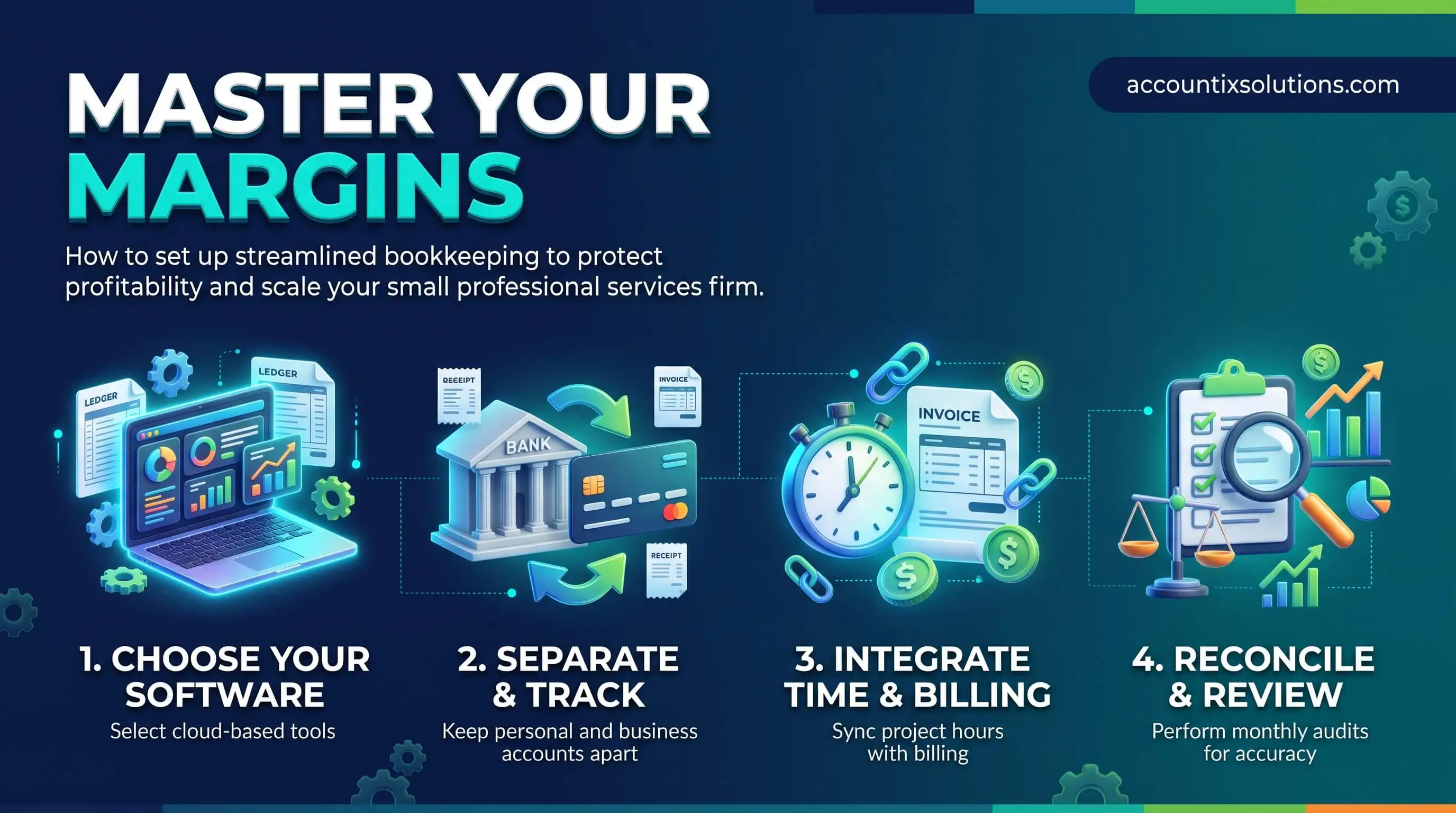
1. Separate Business and Personal Money
Open a business checking account and a business credit card, and run every firm expense through them. If you haven't yet, get an EIN from the IRS and confirm your entity type with your CPA. We also suggest a separate savings account for taxes, with a set share of each deposit moved there, so quarterly estimates don't catch you short.
2. Choose Cash or Accrual Accounting
Cash basis records income when money arrives and expenses when you pay them. Accrual records income when you earn it and expenses when you owe them. Plenty of solo practitioners do fine on cash. Once you take retainers, bill in phases or carry projects across months, accrual gives a far more honest picture. Settle this with your CPA, because the choice carries into your tax filings.
3. Pick Software That Tracks Time and Projects
QuickBooks Online and Xero are the usual hubs for small firms. For a professional services firm, the brand matters less than two features. Your plan should include class or project tracking, and it should sync with the time tracker your team already uses, such as QuickBooks Time or Harvest. Add bill-pay and payroll tools that feed the ledger directly so nobody retypes numbers.
4. Build a Chart of Accounts for a Service Business
Most software ships with a chart of accounts built for retail, so trim it. Split revenue by service line to see what each practice area brings in, and record the people doing billable work as a direct cost. Here's a lean place to start:
Consulting or advisory revenue (income): Fees from your main service line
Project revenue (income): Fixed-fee or phased project billing
Retainers received in advance (liability): Client money you haven't earned yet
Direct labor (cost of services): Wages for staff doing billable work
Subcontractors (cost of services): 1099 contractors on client work
Software and subscriptions (expense): Practice management, time tracking, ledger
Professional fees (expense): Legal, CPA and outside advisors
Professional development (expense): Licenses, CE credits, conferences
Owner or partner draws (equity): Money owners take out of the firm
5. Connect Time Tracking to Invoicing
This step pays for itself faster than any other. Set billable and non-billable codes, enter each client's rate once, and invoice from tracked time on a fixed day each week or month. Turn on automatic reminders before and after the due date. In the first reviews we run, unbilled hours are the leak we find most often, and it's rarely a small one.
6. Track Every Client and Project
Use classes, projects or tags so every invoice, contractor bill and direct expense points to a client. It feels like busywork in week one. By month three, it's how you'll decide which clients are worth keeping at their current rate.
7. Handle Retainers and Client Funds Correctly
An unearned retainer sits on the balance sheet as a liability and moves to revenue as you do the work. Law firms holding client money face a stricter rule. Those funds go in a separate trust account under your state bar's rules and never touch operating cash. Commingled funds are among the costliest setup mistakes a firm can make.
8. Set a Monthly Close Date and Keep It
Choose a day, say the 10th, and close the prior month by then. Reconcile every bank and card account, review unpaid invoices by age, check for unbilled time, and run profit and loss by client. Then lock the period so nobody edits an old month by accident.
The Numbers a Small Firm Should Review Every Month
Once the books close cleanly, a short list of numbers tells you most of what you need.
Utilization rate: How much paid time goes to billable work. Billable hours ÷ available hours.
Realization rate: How much billable work turns into revenue. Amount billed ÷ value of hours worked.
Days sales outstanding: How long clients take to pay. Receivables ÷ revenue × days in period.
Client or project margin: Which work is profitable. (Revenue − direct costs) ÷ revenue.
Months of cash on hand: How long you could cover expenses. Cash ÷ average monthly expenses.
A spreadsheet updated after each close is enough to start. You'll spot a client drifting below margin, or a slow stretch of utilization, well before it turns into a cash problem.
How Setup Differs by Firm Type
The eight steps apply everywhere, though each type of firm has one area that needs extra attention.
Law Firms
Trust accounting comes first. Client funds go in a dedicated trust account, each deposit and withdrawal ties to a named client, and you reconcile the account monthly against client ledgers.
Consulting Firms
Retainers and scope creep are the pressure points. Track hours against each retainer, and you'll see which clients routinely use more time than they pay for before the renewal conversation comes up.
Marketing and Creative Agencies
Pass-through costs like ad spend and printing can inflate revenue. Track them separately so your margin reflects your team's work rather than the media you resold.
Architects and Engineers
Phased billing and long projects make WIP the number to watch. Accrual accounting paired with project tracking keeps costs matched to the phase they belong to.
Setup Mistakes That Cost Firms Money
Running personal and business expenses through the same account
Tracking time in one tool and invoicing from memory in another
Staying on cash basis while carrying months of unbilled work, which hides how the firm is doing
Skipping client or project tracking because "we'll add it later"
Paying contractors without collecting W-9s, then scrambling at 1099 season
Closing the books whenever there's time, which usually means rarely
When to Hand the Books to a Specialist
DIY works while the firm is small and the owner has the hours. The math changes when partners spend billable time on bookkeeping, when more than one owner takes draws, when you hold client funds in trust, or when you need project-level profitability you can rely on. At that point it helps to know what an outsourced accounting team handles month to month, and when a fractional CFO earns a place in planning and growth.
"I can usually tell how a small firm's year went before I open the profit and loss report. I look at the time tracker first. If there are hours from six weeks ago that never reached an invoice, the firm has a billing problem dressed up as a cash flow problem, and no amount of reconciling will fix it. So we connect time to invoicing, set a close date, and hold it for three months. Owners who get through those three months tend to know exactly what they want from an outsourced accounting partner, because they've finally seen what good books look like."
7 Essential Resources
These are the sources I send firm owners to before they set up a single account. Most come from the agencies that write the rules, and the rest fill specific gaps for law firms and growing practices.
IRS: Recordkeeping for Small Businesses. Start here for which records to keep and how long to hold them. Any system you build should meet this baseline without extra effort.
IRS Publication 583, Starting a Business and Keeping Records. Walks through EINs, tax years, single- versus double-entry bookkeeping and how to reconcile a business checking account.
IRS Publication 538, Accounting Periods and Methods. The official word on cash versus accrual, including how the IRS treats advance payments like retainers. Worth reading before your first conversation with your CPA.
SBA: Manage Your Business Finances. Covers balance sheets, accounting methods and the tasks someone in your firm has to own, in plain language.
IRS: Independent Contractor or Employee?. If your firm leans on subcontractors, read this before tax season, because misclassification gets expensive later.
American Bar Association: IOLTAs and Client Trust Accounts. For law firm owners, a clear primer on holding client funds and the records that come with them.
Why Every Business Coaching Entrepreneur Needs Outsourced Accounting Services. A coach's view of the point where handing off the books starts to pay for itself.
These resources provide essential guidance on recordkeeping, accounting methods, client trust accounts, and financial compliance for professional services firms. They help business owners establish accurate bookkeeping practices, manage client funds responsibly, and understand when outsourced professional accounting services can improve financial reporting and streamline day-to-day accounting operations.
Supporting Statistics
Each of these numbers makes the case for books that follow time as closely as they follow transactions.
66.4% billable utilization. SPI Research's 2026 Professional Services Maturity Benchmark found average billable utilization fell to 66.4% in 2025, the lowest in the study's 19-year history and below the 75% it treats as optimal, according to the report's sponsor, Deltek. When a third of paid time goes unbilled, you need books that show where it went.
43 days. Clio's Legal Trends benchmarks put the median realization lockup for law firms at 43 days in 2025. That's how long finished work typically waits before anyone bills it, and it's the gap step 5 is built to close.
51% of small employer firms. The Federal Reserve Banks' 2025 Report on Employer Firms, based on the 2024 Small Business Credit Survey, found 51% of small employer firms dealt with uneven cash flow and 56% had trouble paying operating expenses. Retainers and project billing leave professional firms especially exposed to both.
Final Thoughts and Opinion
My view, after years of reviewing small firms' books, is that very few of them need fancier software. They need two habits. Tracked time becomes an invoice on a fixed schedule, and the books close on the same date every month whether the month was busy or quiet. Nearly everything else in this guide gets easier once those two hold.
The firms that struggle most usually started with a generic small business setup and tried to bolt on project tracking and retainer handling a year later. That cleanup costs far more than building it right at the start.
I'll be candid about DIY, too. Learning how to set up bookkeeping for a small professional services firm is worth the effort even if you hand it off later, since you'll recognize good books when you see them. Once partners are spending billable hours on reconciliations, though, the math flips, and the cheapest bookkeeping becomes the kind someone else does well.

Frequently Asked Questions
What is accounting for professional services firms?
It's how firms that sell expertise and time, such as law, consulting, architecture and engineering practices, record, reconcile and report their finances. On top of standard bookkeeping, it tracks billable hours, unbilled work, retainers and profit by client or project.
Should a small professional services firm use cash or accrual accounting?
Cash basis is simpler, and many solo practitioners use it without trouble. Accrual gives a truer picture once you take retainers, bill in phases or carry work across months. Because the choice affects your tax filings, make it with your CPA.
What software does a small professional services firm need for bookkeeping?
Start with a cloud accounting platform such as QuickBooks Online or Xero, plus a time tracker that syncs to it. Check that your plan includes class or project tracking. Most small firms round out the setup with a payroll platform and a bill-pay tool.
How should a firm account for client retainers?
Record an unearned retainer as a liability when it arrives, then move it to revenue as you complete the work. That keeps one large deposit from making a single month look far more profitable than it was.
Do law firms need a separate trust account?
Yes. State bar rules require unearned client funds to sit in a client trust account, often an IOLTA, kept fully separate from the firm's operating account. Every deposit and withdrawal should tie to a specific client, and you should reconcile the account monthly.
How much time does bookkeeping take for a small firm each month?
It depends on transaction volume and how much of the setup runs automatically. With bank feeds, bank rules and time tracking connected to invoicing, many small firms handle routine entries weekly and spend a few focused hours on the monthly close.
Set Up Your Books Before the Next Billing Cycle
You don't need a perfect system to start. Today, list every bank account, card, software tool and recurring client your firm has. Then block two quiet hours this week to build your chart of accounts and connect your time tracker to invoicing. Those two steps will show you where your margin goes faster than another year of guessing.
When the books start taking more time than they give back, a team that works with professional services firms every day can take it from there, bringing expertise in areas such as accounting for nonprofits, so you can lead with clarity and spend your hours on client work.