Some of it, yes. Brand marketing for therapists runs on what you know about the people you help, and nobody can borrow that from you. Other pieces cost more to do yourself than to hand off, because a mistake there sends the right client to the practice open in the next browser tab.
The work of therapy depends on trust that starts forming long before a first session. Here's how I'd split your branding list, including a few jobs I'd tell you not to pay anyone for.
TL;DR Quick Answers
Brand Marketing For Therapists
Brand marketing for therapists is how a private practice shows the right clients who it helps, how it works, and what a session feels like before anyone books. It's mostly a word job, and the logo is the smallest part of it.
What it covers: your niche, a message written in your clients' own words, a warm and steady voice, and the visuals that hold it together.
Where it shows up: your website, directory profiles like Psychology Today, your Google Business Profile, and your emails.
What keeps it ethical: honest claims, no promised outcomes, and never asking current clients for testimonials.
What you can do yourself: your niche, your directory profile, your Google listing, and a steady newsletter.
What to hire out: homepage copy, a lasting visual identity, technical SEO, and a trademark check on your practice name.
If you're not sure where to start, pay for the task that would cost you the most inquiries if it went wrong.
Top 5 Takeaways
You're the only one who can define your niche, so start there before you spend a dollar on design.
Homepage copy is the task most worth paying for, because strangers read it first and you're too close to it to judge it fairly.
A template logo is fine early. Custom design can wait until your name stops changing.
Your ethics code covers every word published under your name, even the ones someone else wrote.
Hire out the task where a mistake costs the most inquiries, then look at your list again in six months.
What Does Brand Marketing For Therapists Actually Cover?
Branding is mostly a word's job, and the logo is the smallest piece of it. The bigger work is deciding who you help best, what you promise them in their own language, and how you sound everywhere you show up. Colors, fonts, and photos come last, holding it all together.
Most therapists start with the visuals because that's the fun part (I get it). In the practices I write for, though, the logo rarely decides whether someone calls. The words do. Multicultural marketing strategies can also help therapists connect with clients from different cultural backgrounds through language that feels familiar and respectful. If you want the longer version of how those pieces fit, I've written about brand marketing for therapists that builds trust before the first session.
Which Branding Tasks Can Therapists Do Themselves?
If a task depends on knowing your clients and won't quietly break when it's a little rough, it's yours.
Define Your Niche And Ideal Client
Nobody knows your caseload better than you do. Think about the clients you've helped most, and the ones whose names you're glad to see on the schedule. Then write a single sentence that names a person and a moment, like "new parents who stopped really talking somewhere around month three." A consultant can sharpen that sentence, but they can't write it for you.
Draft Your Psychology Today Or Directory Profile
A directory profile is short, and you can rewrite it tonight. Open with who you help and what they're carrying when they find you. Your license can wait until the second paragraph. Give the new version a month, check your profile views, and adjust from there.
Set Up And Complete Your Google Business Profile
Google walks you through setup, so this one mostly takes patience. Fill in every field, pick accurate categories, add a couple of photos of your actual office, and keep your hours current. A lot of what works for finding coaching clients online carries straight over to private practice, too.
Keep A Steady Posting Or Newsletter Rhythm
Consistency beats polish here. One useful post or newsletter a month, in your own voice, will do more than six posts in a burst followed by silence until spring. Keep client details out of all of it, even disguised ones.
Read Your Ethics Code's Advertising Section
Set aside an hour. Psychologists, counselors, social workers, and MFTs each answer to a different code, and every one has rules about claims, testimonials, and endorsements. You'll want to know yours before you approve a single word someone else writes for you.
Which Branding Tasks Need A Professional?
Hire out the work where mistakes are hard to see from the inside and cost you inquiries for months before anyone notices.
Website Copy And Homepage Messaging
Your homepage is often the most-read page on your site, and it's the hardest one to edit yourself because you know too much. Therapists tend to open with training and modalities, which makes sense after all the years it took to earn them. The person reading at midnight mostly wants to know whether you understand what's going on with them. A healthcare copywriter spots that gap fast.
Logo And Visual Identity System
A template logo is fine while you're building a caseload. Once your name and niche feel settled, a designer can give you a logo, palette, and type that holds up everywhere from your website to your intake forms. Redoing a homemade identity two years in usually costs more than getting it right once. Here's a closer look at what a branding agency actually does for a small service business, if you're curious how that process tends to go.
Local SEO And Site Structure
Search problems fail silently. Your site can look lovely and still never show up when someone in your town searches for a therapist who does exactly what you do. A specialist sets up your page structure and tracking so you can see what's working instead of guessing.
Trademark Search For Your Practice Name
Before you order business cards, find out whether someone else already uses your practice name. The federal database is free to search. Reading those results well is a legal question, though, and that belongs with an attorney (not with me, and probably not with you).
Professional Headshots
Your photo ends up on your website and your Google listing, often for years. A local photographer who works with healthcare clients knows how to make you look approachable without looking staged.
Which Branding Tasks Work Best As A Hybrid?
Your bio and your voice guide come out best when you write the first draft and a professional shapes it.
Your Therapist Bio And About Page
You bring the story: why you do this work, who you love helping, and what a session with you actually feels like. A writer turns that toward the client so it reads like an invitation instead of a résumé.
Your Brand Voice Guide
Pick a handful of words that describe how you sound, plus a short list of words you'd never say to a client. A writer can build that into brand voice guidelines you'll lean on every time you write something new.
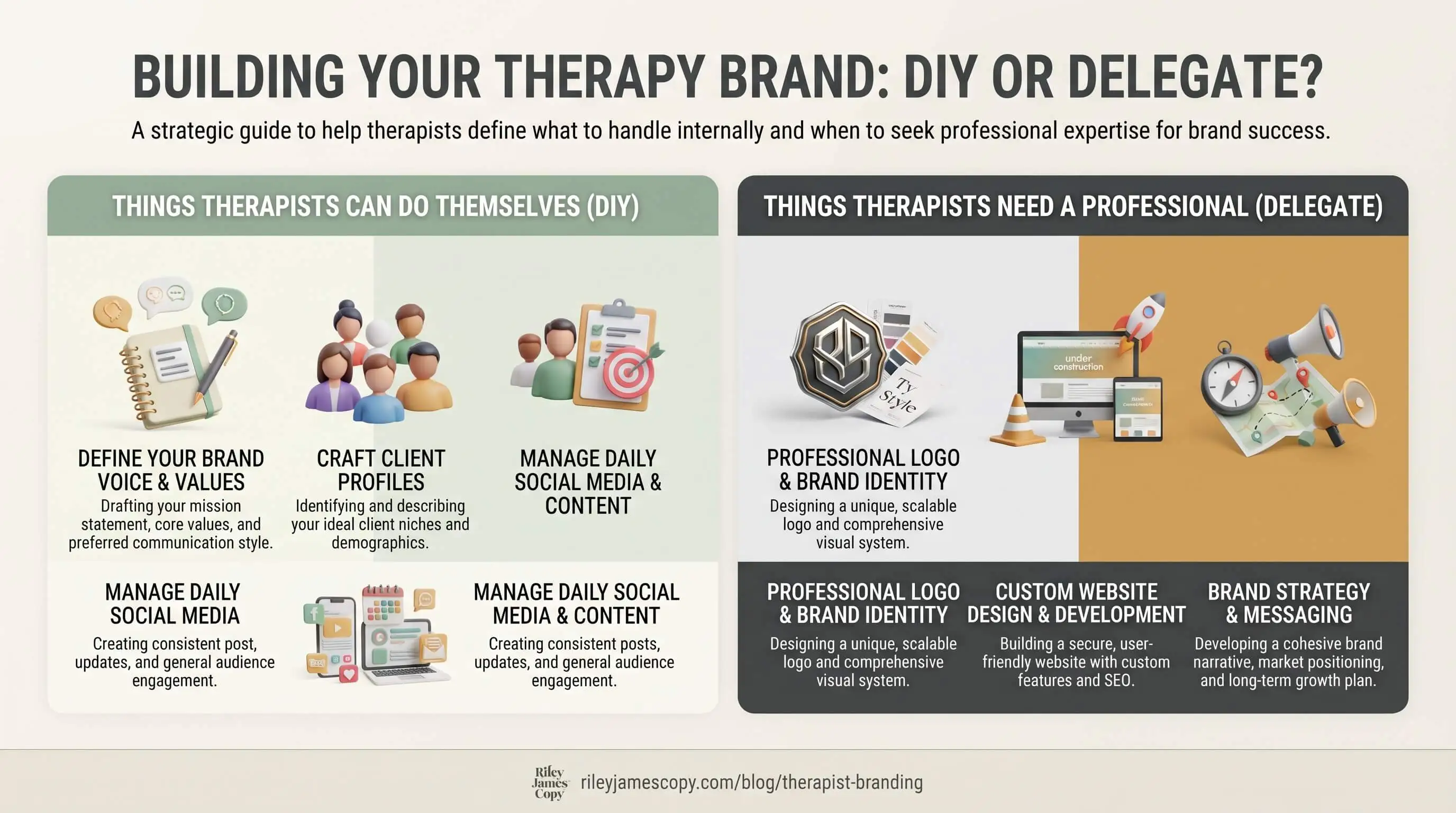
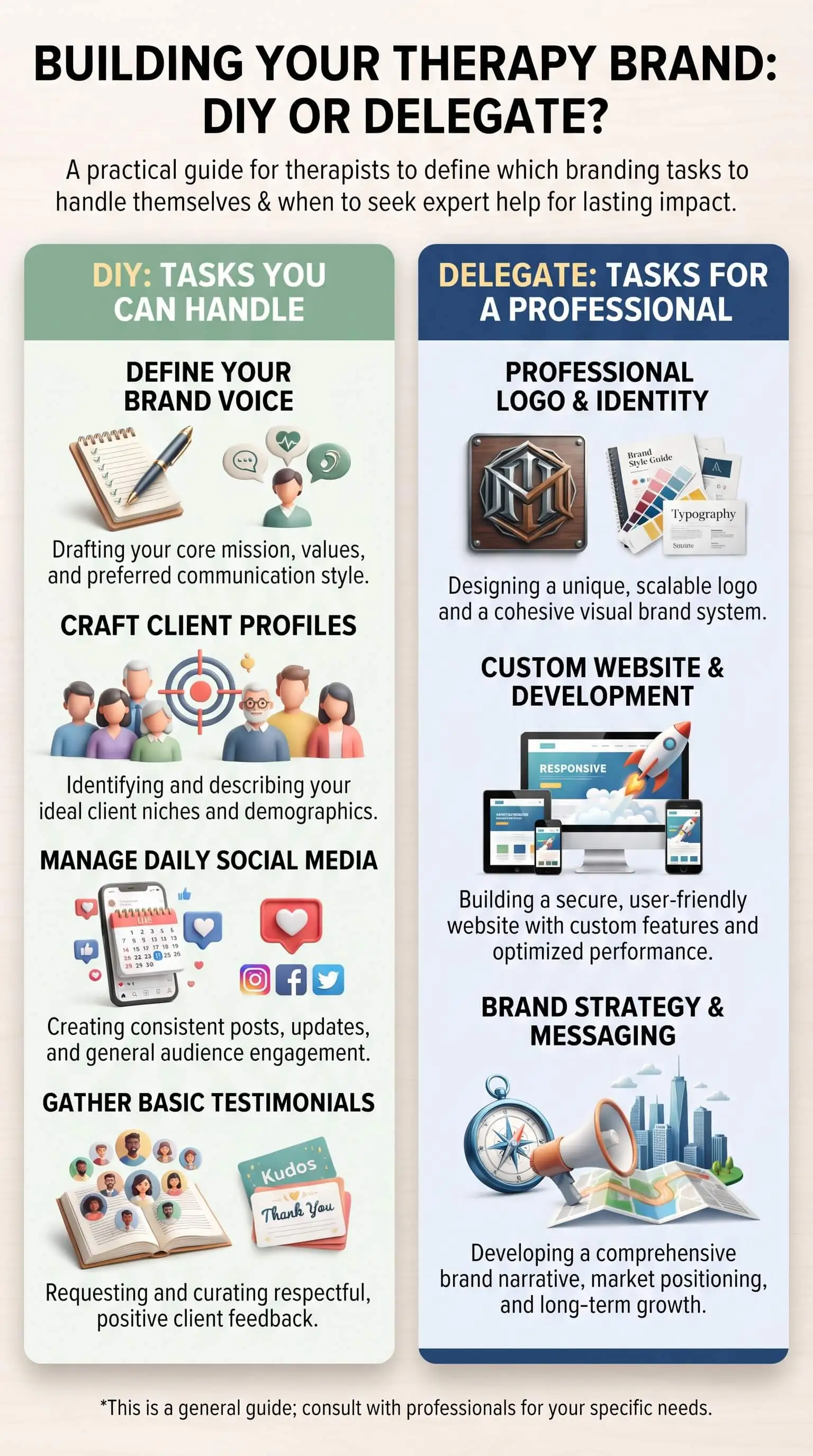
DIY Or Hire? Therapist Branding Tasks At A Glance
Do it yourself
Niche and ideal client: Only you know your caseload, and it's easy to revise later.
Directory profile: Short, quick to edit, and low risk.
Google Business Profile: Guided setup that mostly needs your details.
Posting or newsletter rhythm: Personal and ongoing. The main risk is a privacy slip.
Hybrid
Therapist bio and about page: You draft, and a writer turns it toward the client.
Brand voice guide: You supply the words, and a writer gives them structure.
Hire a professional
Website copy and homepage: The pages strangers read first, and the hardest to judge yourself. Getting this wrong costs inquiries.
Logo and visual identity: Built to last for years, though a template is fine early on.
Local SEO and site structure: Technical, and it fails without telling you. Hire it out or go hybrid.
Trademark search: A legal question for an attorney.
Headshots: Used everywhere for years, so it's worth a photographer.
When you're stuck, ask what a mistake would cost you. The task with the steepest price is usually the one worth paying for.
How Should A Therapist Decide What To Hire Out First?
Hand off the one task where a mistake would cost you the most clients, and keep doing the rest yourself for now.
Write down every branding task on your plate.
Estimate the hours each would take you, then count the sessions those hours would replace.
Rank the list by what a mistake would cost you in inquiries.
Hand off the top one or two.
Come back to the list in six months, because your practice will have changed by then.
You've probably outgrown doing it all yourself if people visit your site but rarely reach out, or if your profiles describe you in different ways. Branding eating the evenings you need for rest is a sign, too.
What Should You Look For When You Hire Branding Help?
Look for someone who asks about your ethics code before they ask about your colors. In my experience, that one question tells you most of what you need to know. The same principle applies to a board game crowdfunding strategy, where understanding the rules and responsibilities matters before focusing on visual appeal. A good partner for brand marketing for therapists also:
Reads your profession's code before writing anything
Won't promise you a number of new clients
Never suggests asking current clients for testimonials
Understands HIPAA limits for newsletters and email
Shows you a price before you sign
"When a therapist sends me a homemade website, the clinical insight is almost always there somewhere, usually buried under credentials and modalities. What I do is move the things they already say in session onto the page, in the order a nervous reader needs them. That's why I tell most solo therapists to keep writing their own directory profile and hand me the homepage. They know their clients better than I ever will, and I've spent years watching how strangers skim."
Essential Resources
Before you write or hire anything, here's where I'd send you. Every one is a primary source, and I've ordered them roughly from ethics to privacy to protecting and promoting your practice.
Know The Psychology Rules Before You Write A Word
Section 5 of the APA Ethics Code covers advertising, directory listings, and testimonials. It also says psychologists stay responsible for anything they hire someone else to write, which is worth remembering when you hand off your homepage.
Source: American Psychological Association: Ethical Principles of Psychologists and Code of Conduct
Check The Counseling Standards For LPCs
The ACA's ethics hub hosts the 2014 ACA Code of Ethics, including guidance on social media and technology. A revision is in progress, so the 2014 version still applies until the new one is adopted.
Source: American Counseling Association: Ethics Resources
Present Social Work Credentials Honestly
Clinical social workers will find their standards for professional conduct here, including how they apply when you reach clients through technology. Read it before you publish a bio.
Source: National Association of Social Workers: Code of Ethics
Keep Your MFT Marketing Current
The AAMFT's revised Code of Ethics took effect January 1, 2026. If you're a marriage and family therapist, check your website and profiles against this newest version.
Source: American Association for Marriage and Family Therapy: Code of Ethics
Protect Client Privacy In Every Newsletter
HHS lays out how the HIPAA Privacy Rule defines marketing and when you need a client's written authorization. Give it a read before your first email goes out.
Source: U.S. Department of Health and Human Services: HIPAA Marketing Guidance
Clear Your Practice Name Before You Build On It
The USPTO explains what a trademark is, why you should search for similar marks first, and when an attorney makes sense. It's a short read, and much cheaper than renaming a practice.
Source: U.S. Patent and Trademark Office: Trademark Basics
Finish The Profile Clients Often See First
Google says complete, accurate profiles are more likely to appear in local results, and that ranking comes down to relevance, distance, and prominence. It's the clearest checklist I know for one of your best DIY tasks.
Source: Google Business Profile Help: Tips to Improve Your Local Ranking
These essential resources offer medical copywriting tips for therapists, covering ethical advertising, accurate professional credentials, client privacy, trademark protection, and Google Business Profile optimization to help build a trustworthy and compliant private practice brand.
Supporting Statistics
I keep these numbers in mind whenever a therapist asks me what to do first.
1. More Practices Are Competing For The Same Clients
BLS projects employment in offices of mental health practitioners to grow 21% from 2022 to 2032, from about 166,400 jobs to 201,600. That's the fastest rate among the mental health industries in its analysis.
More practices means more homepages that sound alike, which is why website copy sits at the top of my hire list.
Source: U.S. Bureau of Labor Statistics: Careers in Mental Health Services
2. About Half Of Adults With A Mental Illness Still Go Without Treatment
In 2022, 50.6% of the 59.3 million U.S. adults with any mental illness received mental health treatment in the past year.
Cost and access explain part of that gap. Some people also can't tell who's safe to call, and plain, warm words on your profile can make that first call feel less risky.
Source: National Institute of Mental Health: Mental Illness Statistics
3. Most Health Searches Start On A Search Engine
In Pew's Health Online 2013 report, 77% of online health seekers said their most recent search began at a search engine like Google.
The survey ran in 2012, so read it as a long-standing habit rather than a new trend. It's also why I put your Google Business Profile on the DIY list instead of letting it sit half-finished.
Source: Pew Research Center: Health Online 2013
Final Thoughts And Opinion
Here's where I land after years of writing for healthcare practices. Most therapists can handle more of their own branding than the people selling branding like to admit.
Your niche, your directory profile, your Google listing, and your newsletter all grow out of knowing your clients, and you already do that every day. I'd spend money somewhere narrower, on the pages a stranger reads first. Once your name and niche stop moving, a visual identity is worth it too. Anything that turns out to be a legal question goes to an attorney.
I learned how quickly first impressions form long before I wrote a copy for a living. Ten years in ministry showed me that people decide whether to trust you in the opening sentences, well before you get to the part you're proud of. Your future clients do the same thing on your homepage.
And if a sharper Psychology Today profile is all you really need, I'll say so. Plenty of practices start getting the right calls without a full rebrand.
Frequently Asked Questions
Q: Can Therapists Do Their Own Branding?
A: Yes, a good share of it. Your niche, directory profile, Google Business Profile, and newsletter are all within reach. Homepage copy and a lasting visual identity are harder to judge from the inside, so those are the pieces I'd hand off.
Q: Is Canva Good Enough For A Therapy Practice Logo?
A: Early on, it's fine. A clean template logo works while you build a caseload. Once your name and niche settle, a designer can give you something that holds up for years.
Q: Should I Write My Own Therapist Website Copy?
A: Draft it, then get help with it. You know your clients best, but most therapists open with credentials instead of the reader's struggle. A copywriter who knows your ethics code can turn that draft toward the person reading it.
Q: What Should A Therapist Hire Out First?
A: Whatever would cost you the most inquiries if it went wrong. For most solo practices, that's the homepage.
Q: How Much Does Professional Therapist Branding Cost?
A: It depends on scope. A logo, a full website, and a single page are very different projects. I work on a sliding scale, and most single-page projects run a few hundred dollars. You'll see an actual number before you sign anything.
Q: What's The Difference Between Branding And Brand Marketing For Therapists?
A: Branding is your message, meaning who you help, what you promise, and how you sound. Brand marketing for therapists puts that message to work on your website, in directories, in search results, and in email.
Q: Can A Branding Professional Help Me Stay Within My Ethics Code?
A: A good one reads your code first and flags risky claims before they go live. I'm a copywriter and not a compliance attorney, though, so you and your licensing board's rules make the final call.
Ready For A Brand That Builds Trust Before The First Session?
You've already sorted what you can handle on your own. If your homepage or bio landed on the hire list, grab a free 15-minute call and we'll work out together what your brand needs first, how private practice healthcare copywriting can help, and what it can skip.


